When people think about magic, they often picture a stage illusion, a television special, or a magician producing a rabbit from a hat. What many people never discover is that magic is also one of the most rewarding hobbies anyone can take up, whatever their age or background.
At The Order of The Magi, we regularly meet people who first became interested in magic as children, alongside others who only discovered the hobby after retirement. Some members perform professionally, while many simply enjoy learning new skills, meeting like-minded people and experiencing the satisfaction that comes from entertaining friends and family.
Magic is unusual because it combines creativity, practical skill, psychology, performance and lifelong learning in equal measure.
Building confidence, one performance at a time
One of the greatest benefits of learning magic has very little to do with tricks.
For many people, standing in front of others and speaking confidently is one of life’s biggest challenges. Even introducing yourself to a room full of strangers can be daunting.
Magic offers a gentle way to overcome those fears.
Most magical performances begin with just one spectator. As confidence grows, that audience might become a family gathering, a workplace, a social club or eventually a theatre full of people. Each successful performance builds self-belief, helping performers become more comfortable communicating with others.
Many magicians will tell you that they were once painfully shy. Magic gave them a reason to engage with people and, perhaps more importantly, a reason for people to engage with them.
Learning to communicate
A good magician is not simply someone with quick hands.
The best performers know how to tell a story, create suspense, use humour, ask questions and guide an audience’s attention. These are valuable communication skills that can be useful far beyond the world of magic.
Whether speaking to customers, giving presentations at work or simply becoming more confident in everyday conversations, many of the techniques developed through performing magic naturally transfer into daily life.
In fact, experienced performers often say that audiences remember how you made them feel long after they have forgotten exactly what happened.
Keeping the mind active
Learning magic provides a healthy challenge for the brain.
There are routines to remember, presentations to develop and performances to refine. Many magicians also enjoy reading books on psychology, theatre, history and storytelling alongside their practical studies.
Unlike many hobbies, there is always something new to learn.
Even performers with decades of experience continue discovering fresh ideas, improving old favourites and learning from fellow magicians. It is one of the reasons magic remains such a fascinating pursuit throughout life.
A hobby that grows with you
Some hobbies rely on physical fitness or expensive equipment.
Magic can be enjoyed almost anywhere.
A deck of cards, a few coins or even everyday objects can provide countless hours of practice and enjoyment. As interests develop, some people become fascinated by close up magic, others by stage illusion, comedy magic, mentalism, children’s entertainment or the rich history of the art itself.
There is no single path through magic, which means the hobby can evolve as your interests change over the years.
Making lasting friendships
Ask almost any magician what they value most and many will mention the friendships.
Magic has always been a social art. Ideas are shared, performances discussed and experiences exchanged. Watching another magician perform can often be just as inspiring as learning something yourself.
That is why magic societies have played such an important role for well over a century.
Founded in 1909, The Order of The Magi has welcomed generations of magicians from across Manchester, Greater Manchester and beyond. Club evenings bring together experienced professionals, enthusiastic amateurs and complete beginners, all with a shared appreciation for the art of conjuring.
Many lifelong friendships have begun with a simple conversation over a pack of playing cards.
Magic for every generation
One of the pleasures of attending a magic club is seeing different generations learning together.
A younger member may introduce the latest ideas they have discovered, while someone who has been performing for fifty years can share stories and knowledge that cannot be found in books.
Both have something valuable to offer.
Magic has a remarkable ability to bring people together through curiosity, creativity and a shared sense of wonder.
More than entertainment
Although audiences see only the finished performance, magic offers much more than entertainment to those who practise it.
It encourages patience, develops resilience and rewards careful practice. It teaches performers how to think creatively, solve problems and connect with people in memorable ways.
Perhaps that is why so many people who discover magic never really leave it behind.
Whether you are eight or eighty, learning magic can become a lifelong journey of discovery, friendship and personal growth.
If you have a genuine interest in the art of magic, whether you are an experienced performer or someone keen to develop your skills, The Order of The Magi would be pleased to hear from you. Prospective members are welcome to contact the Society to discuss visiting a meeting as a guest and discovering what membership has to offer.
If you have ever thought about joining a magic club, you have probably wondered what actually goes on behind closed doors.
Is it all top hats and secret handshakes? Is there some sort of magician’s oath? A mysterious initiation? A hidden room beneath Manchester where members gather around candlelight discussing card controls?
Well… not quite.
Despite what some people imagine, joining a magic society is nothing like joining the Freemasons, and sadly rather less like Hogwarts than many of us might secretly hope.
At its heart, a magic club in the UK is simply a place where people with a genuine interest in magic come together to learn, socialise, share ideas, and occasionally fool one another with a magic trick they absolutely insist is “still a work in progress”.
So… what actually happens at a magic club?
The answer is: quite a lot.
At The Order of The Magi, our meetings range from professional magic lectures through to social nights, practical sessions, competitions, fundraising shows, and plenty of opportunities to learn, collaborate, and build friendships with others who share a passion for magic.
A typical year might include:
Guest lectures from some of the biggest names in magic
Club nights to perform, practise, and share ideas
Friendly magic competitions
Informal “jam nights” where members session together
Fundraising shows and performances
Social events including BBQs and our Christmas Party Pub Crawl
Sales, discussions, and occasional surprises
In short, there is usually something happening for every kind of magician.
Whether your interest is close-up magic, stage illusion, comedy magic, children’s entertainment, mentalism, bizarre magic, escapology, hypnosis, or simply an appreciation for the art, there will almost certainly be someone who shares your enthusiasm.
Do you have to perform?
Not at all.
This is probably one of the biggest misconceptions about joining a society for magicians.
Some members perform professionally. Others are enthusiastic amateurs. Some have been studying magic for decades but rarely perform at all. And some simply enjoy collecting books, learning about magical history, or discussing methods and presentation.
Nobody is forced to stand up and perform.
Of course, if you want to try material in front of a friendly audience, you will usually find plenty of encouragement and constructive advice from people who genuinely want to help.
Is it all about secrets?
Yes… and no.
Let’s be honest, magicians do enjoy secrets. It comes with the territory.
But if your only interest is discovering “how tricks are done”, you may find joining a magic society a little disappointing.
The real fascination of magic goes far beyond methods.
Presentation, timing, psychology, performance, scripting, audience management, comedy, storytelling, character, misdirection, and even stagecraft often matter far more than the mechanics of a trick itself.
In many ways, the secret is usually the least interesting part.
A good magic society is really about developing an appreciation for the art of magic and sharing ideas with others who genuinely enjoy it.
What happens at The Order of The Magi?
Founded in 1909, The Order of The Magi is one of the oldest magic societies in the world and has been bringing together Manchester magicians for well over a century.
We typically meet on the 2nd and 4th Tuesday of each month at our headquarters:
The Irish World Heritage Centre,
Irish Town Way,
Queens Road,
Cheetham Hill,
Manchester M8 0RY
Across the year, members enjoy a varied programme of lectures, club nights, competitions, social events, fundraising shows, and plenty of opportunities to talk magic with like-minded people.
Some members are full-time professionals, others perform occasionally, and many simply enjoy magic as a fascinating hobby.
The one thing most members have in common is a genuine love of the art.
Thinking of joining a magic club in Manchester?
If you have a genuine interest in magic and would like to meet others who share it, why not come along and experience a meeting for yourself?
Visitors are welcome to selected meetings and lectures by prior arrangement, making it a great way to see what a magic club in Manchester is really like before deciding whether membership is right for you.
Whether you are an experienced performer, a complete beginner, or simply someone with a serious interest in magic, you will always find a warm welcome at The Order of The Magi.
Frequently Asked Questions About The Order of The Magi
Do I have to be a professional magician to join The Order of The Magi?
Not at all. Our members include full-time professionals, part-time performers, hobbyists, collectors, and people with a serious interest in magic. What matters most is a genuine enthusiasm for the art of magic.
I am new to magic. Can beginners join?
Yes. While some members have been involved in magic for many years, others join to learn more and develop their skills. The Order of The Magi welcomes people at different stages of their magical journey, provided they have a genuine interest in magic.
Do I have to perform at meetings?
No. Nobody is required to perform. Some members love getting up to demonstrate routines or ideas, while others prefer to watch, learn, and enjoy the atmosphere. Participation is entirely up to you.
Can I visit before applying for membership?
Yes. Visitors are welcome to selected lectures and meetings by prior arrangement. Visiting is a great way to experience The Order of The Magi and see whether membership is right for you before applying.
When and where does The Order of The Magi meet?
The society usually meets on the 2nd and 4th Tuesday of each month at the Irish World Heritage Centre, Manchester. Meetings include lectures, club nights, competitions, practical sessions, and social events.
What kind of events do members enjoy?
Alongside our regular magic lectures and club nights, members enjoy competitions, jam nights, fundraising performances, BBQs, our Christmas Party Pub Crawl, Dealers Days, and other social activities throughout the year.
Is The Order of The Magi just about learning secrets?
Not really. While magic naturally involves secrets and methods, most members quickly discover that presentation, psychology, audience engagement, humour, timing, and performance are often far more important than simply knowing how a trick works. If you have a genuine interest in magic, you will find plenty to enjoy. If you are simply looking for secrets, you may find the reality rather different from what you imagined.
How much does membership cost?
We offer several membership categories, including town, country, student, and partner membership options, making joining one of Manchester’s oldest magic societies affordable for a wide range of people.
How do I join The Order of The Magi?
You can apply online through our membership page or download a printable application form. If you are unsure whether membership is right for you, we are always happy to answer questions or arrange a visit to one of our meetings.
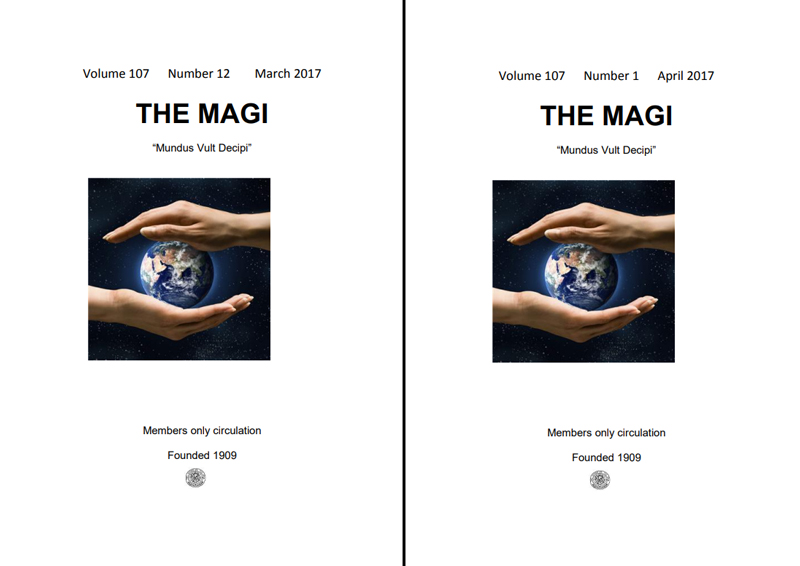
For more than a century, members of The Order of The Magi in Manchester have received a monthly copy of The Magi magazine, the Society’s long-running journal covering magic, magicians, lectures, performances, club news, and the rich history of one of the UK’s oldest magical societies.
Recently, a question was raised regarding the numbering of The Magi magazine and whether the 2026-2027 Society year ought to be appearing as Volume 118 rather than Volume 116. What initially seemed like a small point of curiosity soon developed into a fascinating journey through more than 100 years of magical history, archive material, and Society records.
Following a detailed review of physical copies of The Magi magazine, digital archive scans, photographs of historical editions, and supporting correspondence, it has become clear that the correct numbering for the 2026-2027 Magi year should in fact be Volume 117.
The Beginning of The Magi Magazine
The earliest available evidence for The Magi magazine’s publication can be found in a contemporary archive article concerning the Society’s first editor, R. Mervyn Varney. The piece states:
“R. Mervyn Varney was the first editor of ‘The Magi’ the monthly Journal started in May 1910 and published every month without interruption up to the present day. He was taken ill in August 1910 and had to relinquish his editorship. His death in July 1911 was a great loss”.
This historical reference confirms that the first issue of The Magi was published in May 1910, making it Volume 1, Edition 1.
Since then, The Magi has been published every single month, documenting the life of The Order of The Magi, magical performances, lectures from leading magicians, club events, competitions, and the ever-evolving world of magic in Manchester and beyond.
A Historical Numbering Error in 1950
The investigation uncovered evidence of an earlier numbering anomaly.
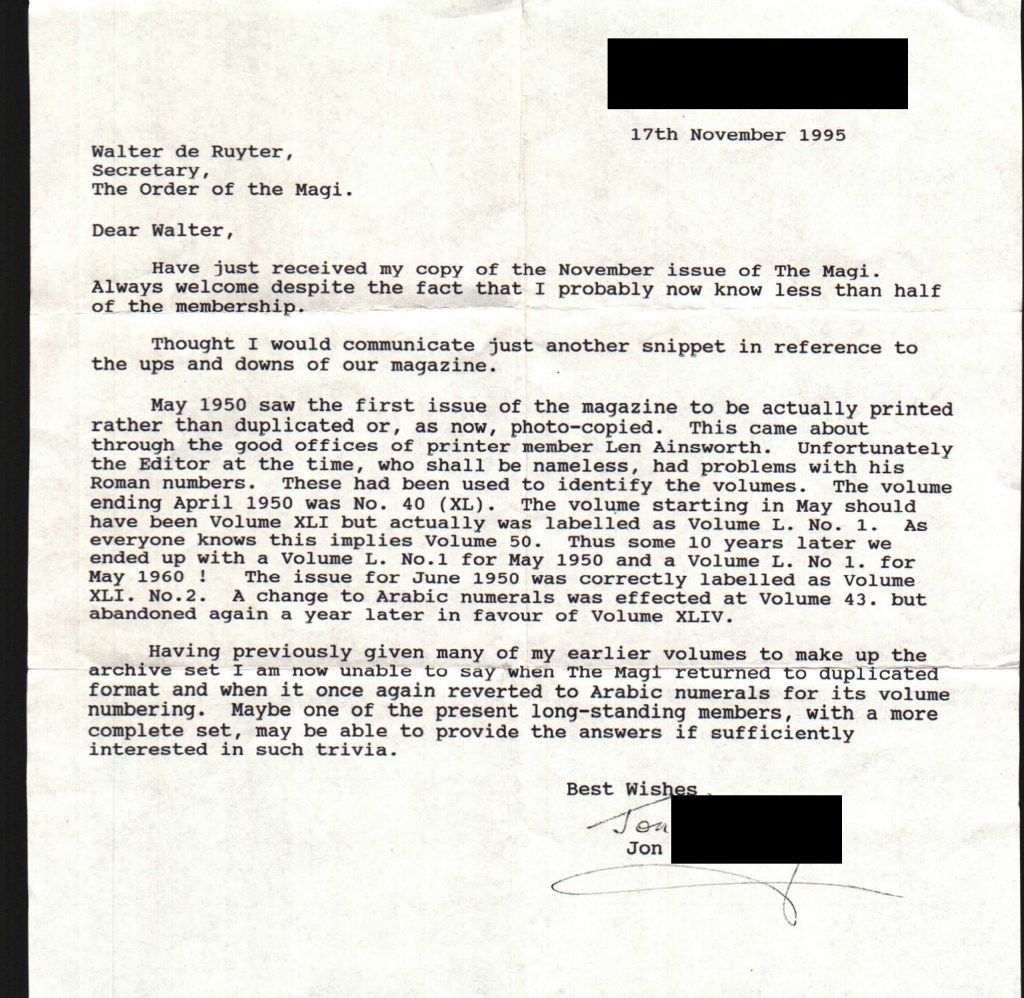
A letter held within the Society archives, dated November 1995 and addressed to then Secretary Walter de Ruyter, explains that a mistake occurred in May 1950, when what should have been printed as Volume 41 Edition 1 instead appeared as Volume 50 Edition 1.
The error was corrected in June 1950, though it did leave the unusual situation of there technically being two separate editions of Volume 50 Edition 1, published ten years apart.
Interestingly, the May 1950 issue also appears to have marked an important milestone in the Society’s history, being the first edition of The Magi to be professionally printed rather than duplicated.
The Change to the Magi Year in 1988
For much of its history, The Magi magazine followed a straightforward publishing cycle, with each volume running from May through to April.
However, in 1988 a subtle but important adjustment appears to have been made.
At first glance, Volume 78 (1987-1988) seems to contain only eleven editions, raising suspicions of a missing issue. Closer examination, however, revealed that no magazine had been lost at all.
Instead, what would have been published as Volume 78 Edition 12 appears to have been deliberately renumbered as Volume 79 Edition 1, bringing the magazine into alignment with the Society’s April to March syllabus year.
From that point onward, The Magi volumes ran from April to March, ensuring the magazine year reflected the annual cycle of The Order of The Magi more accurately.
The Source of Today’s Confusion
The apparent “missing year” can be traced to a far more recent administrative oversight.
Volume 107 ended in March 2017, meaning the following issue, published in April 2017, should naturally have begun Volume 108 Edition 1.
However, the April 2017 edition was mistakenly published as Volume 107 once again.
As a result, Volume 107 ultimately ran for twenty-four editions rather than twelve, unintentionally placing every subsequent volume number one year behind where it should have been.
Given the practical realities of producing a monthly magazine for a busy magic society, this appears to have been an entirely understandable oversight that simply continued unnoticed over time.
Why the Correct Number Is Volume 117
After cross-checking publication dates, volume numbers, surviving archive material, and historical correspondence, the evidence consistently points to the same conclusion:
The correct volume number for the 2026-2027 Magi year is Volume 117.
The Society is therefore updating the numbering moving forward to ensure the historical record accurately reflects the remarkable continuity of The Magi magazine.
More Than a Magazine: A Living Record of Magic in Manchester
Perhaps the most important discovery from this research is not a numbering correction, but a renewed appreciation for the extraordinary history of The Order of The Magi itself.
Founded in Manchester in 1909, The Order of The Magi remains one of the UK’s oldest magic societies and continues to welcome magicians of all abilities through lectures, club nights, competitions, and special events.
The Magi magazine stands as an important part of that legacy. Published continuously every month since May 1910, it serves as a living historical record of magic in Manchester, preserving over a century of magical knowledge, Society news, visiting lecturers, performances, and memories.
The Society is proud that The Magi remains recognised as the longest-running monthly magical magazine to have been continuously published without interruption, a remarkable achievement and one that reflects the dedication of generations of members, editors, and volunteers.
The Order of The Magi would also like to thank members who contributed thoughts, archive material, photographs, and discussion during the investigation into the magazine numbering. It is hoped that this clarification will help preserve the Society’s history for future generations of magicians in Manchester and beyond.
Over the years, The Order of The Magi ‘s news and events has been published on MagicWeek – an online news site for magicians around the world, that has been updated every week for 22 years – and we are extremely grateful to Duncan Trillo for his support in our activities. So when Duncan published that individuals and societies could become a supporter of his site for a small donation towards the running costs, it was with great pleasure that we said “yes!” – a small gesture of thanks to him and his amazing website, for everything he has done for The Magi over the years.
MagicWeek is updated every Saturday with magical news, reviews, private sales, listings of upcoming events and much more – and is an excellent resource for both the amateur and professional magician. If you have an interest in magic, or allied arts, visit MagicWeek – you can thank us later!
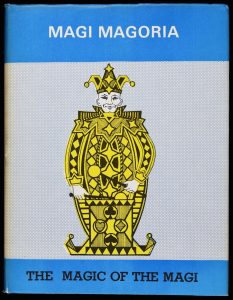
The article below, written by former editor of The Order of The Magi, Bayard Grimshaw, has been reproduced from Magi Magoria, published by Supreme Magic in 1974. It offers a fascinating glimpse into the early history of magic in Manchester, the development of performing magic in the city, and the story of The Order of The Magi itself – one of the world’s oldest societies dedicated to the art of magic and magical performance.
Although written more than fifty years ago, the article provides a valuable snapshot of Manchester’s magical heritage up to the time of publication and reflects the rich tradition of magicians, magic clubs, and variety entertainment that helped shape the city’s magical community.
Much has changed in the world of magic since 1974, and perhaps one day a new generation of members of The Order of The Magi may continue the story, documenting the history of magic in Manchester from the mid-1970s to the present day, preserving the memories, performers, venues, and events that have helped keep Manchester’s magical tradition alive.
MAGIC IN MANCHESTER
(Not just we Magi but also)
BAYARD GRIMSHAW
Understandably, the origins of Magic are obscure and a matter for speculation. We may assume that among our remote ancestors, as far back as the beginnings of community life, there came to the fore the “wise men”, those whose special knowledge of natural principles enabled them to keep a step ahead of the rest and to astound their fellows by their ability to bring about strange and awe-inspiring results. They would use their power for the common good, or for personal prestige, and perhaps – who knows ? – to amuse and entertain, too.
The first written record of a magical performance as we understand the term today was contained In the Westcar Papyrus, the present whereabouts of which are in doubt: it described a display of Magic given by one Dedi, at the court of King Cheops in Egypt nearly six thousand years ago. Of the precise achievements of the Magi of the Ancient East we know little, though their reputation as wonder-workers has come down to us over the years, and inspired the title of the Order of the Magi.
Of Magic as entertainment during the centuries of the Greek and Roman civilisations we have ample evidence. A Greek writer of the third century has left us a detailed description of a performance of the sleight-of-hand feat known as the Cups and Balls, which, he wrote, “rendered me almost speechless and made me gape with surprise”; the routine he described might pass for one of the present day. Seneca, the great Roman philosopher, wrote of the same feat, and sensibly, wise man that he was, added: “If I get to know how a trick is done, I lose my interest in it”. In those days it was done with round white pebbles and wine-cups, and it was from the name of the latter that the performer came to be known by the Romans as an “acetabularius”.
So it is plausible to assume that the soldiers who garrisoned the Roman fort of Mamucium on the banks of the Irwell may well have been entertained, at times when the rude Brigantes ceased from troubling, by gifted comrades or by itinerant acetabularii. To their days, the first century A.D., we can ascribe the probable beginnings of Magic in Manchester.
As a centre of trade the city must have attracted, especially on market days, many of the travelling “jugglers” who made their way from town to town from the eighth to the sixteenth centuries. Probably such performers as Banks and Richardson in the seventeenth century, and Fawkes, Pinchbeck, Yeates, Comus and Jonas in the early eighteenth, visited Manchester, for they are known to have toured the provinces. Breslaw, the German who achieved such success in England, certainly appeared here several times between 1773 and 1782; so, almost certainly, did Katterfelto and probably too the illustrious Pinetti.
By the time we come to the nineteenth century we have more precise information. Ingleby visited Manchester in 1808; Philippe (Talon) in 1839, Dobler in 1842; the famed Anderson, the “Wizard of the North,” in 1838-39 and again in 1841; Jacobs in 1850 and probably earlier, between 1834 and 1838; while Buck had a “record run” of a hundred consecutive nights in Manchester in 1851. The first Bosco was here about 1857, and Frikell in 1858.
But one instance of Magic in Manchester, looking back a century or so, stands out above the rest: that visit of Robert-Houdin, “father of modern magic”, to the Theatre Royal in 1848. An original playbill, announcing the event, is a treasured possession of the Order of the Magi, and is handed into the care of each new President on the occasion of his installation. “The theatre in this city is immense”, wrote Robert-Houdin in his Memoirs: “It can hold an entire people … Twelve hundred spectators scarcely filled the pit”. And he goes on to devote seven pages to an account of his successful first night.
And so we come to the years of the great illusionists, all of whom visited Manchester on many occasions and attracted huge audiences to the numerous theatres of the city and its surrounding districts. Manchester was not only a stronghold of entertainment but a place of theatrical stores and workshops, the centre of the great Broadhead Tour; it was said that one could lodge in Rumford Street or Brunswick Street and do a year’s work on the halls, travelling back to one’s “digs” each night by tramcar.
The latter years of the last century, and the first decades of the present, were a golden age of Magic; the art, ever popular with the entertainment-loving public, flourished as never before. Most variety bills had their magician, be he merely a front-cloth act with no more of a repertoire than a few card sleights; but the princes of the profession were those who toured a full show, with their lavish publicity and their own scenery, their regiments of well-trained assistants, their floating ladies and their vanishing ladies and their incredible productions and transpositions.
Hartz, Servais Le Roy, Rameses; Devant, Carl Hertz, De Biere, Lingha Singh; Lafayette, Chung Ling Soo, Houdini, Goldin, The Great Carmo – their names spelt glamour and mystery. Their interviews appeared in the press, articles about them in the weekly and monthly magazines. Their advent to a local theatre, heralded by intriguing posters on the hoardings, aroused delicious anticipation: one could hardly wait for the week to come. And their mysteries provided ample material for speculation and discussion for weeks afterwards.
We must not forget that alongside of these “greats” flourished the lesser lights of the concert and the children’s party, the ladies’ evening, the soiree and the conversazione. Such were the majority of the founders and early members of the Order of the Magi. They basked in the limelight touched off by their more famous elder brethren, they were in great demand and their date books were full.
Came the time when the variety theatres reeled under the successive blows of the silent cinema and the “talkies”, radio and eventually television; when recording “stars” topped the bills in the larger of what few Hippodromes and Palaces survived, “strip” shows the smaller, leaving scant space for the stage magician. For a while Dante, Kalanag, Lyle, Murray, Levante and a few more tried to keep alive the tradition of the big magical show in this country. But in the end it was largely left to the magical societies to keep Magic alive.
At the turn of the century magicians from all over the world, and local magicians in particular, amateur and professional, little-known and well known, used to foregather on Sunday afternoons and evenings at the home of Harry Whiteley at 86 Medlock Street. Mr. Whiteley, performer, author and magical dealer, had countless friends in Magic; he was British correspondent of ‘The Sphinx’, the great American magical monthly. Famous illusionists, touring the provinces, would when possible break their journeys in Manchester in order to spend an hour or two at Harry Whiteley’s; others, working within travelling distance, would come over just for the pleasure of spending a short time with kindred spirits.
Such a one was Chung Ling Soo (W.E. Robinson). Believed by all save those in the know to be genuinely Chinese, he was actually born in America, of Scottish ancestry; but he seemed to have a special affection for Manchester, where he had many friends, and for many years he had a store and workshop at Bolton, where his colleague Ritherdon designed and made much of his elaborate apparatus and scenery.
These informal gatherings led to the formation of an equally informal society, “The Friends of Magic;” Soo was the President. Though this association did not directly lead to the formation of the Order of the Magi, it no doubt had an indirect influence, and it was, as far as we know, the first banding together of magicians in the Manchester area.
It was probably at Harry Whiteley’s house that G. W. Panter, M. A. , a keen student of magic a member of the recently formed Magic Circle, met fellow conjurors and, realising their strength, saw the desirability of forming in Manchester a more formally constituted society. At first he consulted with the Council of the Magic Circle, with a view to instituting a northern branch of that body; this was found, for several reasons, to be impracticable. And so, emboldened by news of the success of two magical societies in the U.S.A. , the Society of American Magicians and the Detroit Circle, and two in England, the British Magical Society in Birmingham and the Northern Magical Society – now long defunct – in Liverpool, as well as the Magic Circle itself, Mr. Panter embarked upon the formation of a new society altogether.
An advertisement was placed in the local papers, and a notice displayed in Waite’s magic-shop-cum-barber’s in Peter Street near to the old Tivoli Theatre, inviting those interested to meet on the 11th March, 1909, at the Cities Hotel, Deansgate. About thirty conjurors attended; support was assured, and with enthusiasm the new Society was duly formed. Mr. Panter was elected President; Mr. Waite became Treasurer and Librarian; and Mr. T. H. Halsall was the first Secretary. On second thoughts he found that he could not spare the necessary time, and two days later he was succeeded by J. W. Riley (“De Meglio”), a well-known performer who managed Wiles’ conjuring department and entertainment bureau for many years.
Among those present was a young man named Ronald Bumby, who became President in 1967 and is still happily with us in 1977.
Business being concluded, there was an impromptu entertainment. The first trick, Diminishing and Vanishing Cards, was shown by dear old Arthur Buckle, a well-loved member who became President in 1947 and remained active until his death in 1954; another performer was Mr. Halsall, President from 1936 to 1946, who, the report says, “proved himself to be a master of coins”.
The as yet unnamed society promised well from the start. At the next meeting probably inspired by President Panter, the title “The Order of the Magi”, a happy choice, was decided upon. The Order was fortunate in having among its members an artist and process engraver, Mr. Holmes, and a printer, Mr. Wildman; so well-designed letter-headings and programmes were readily available. During the first year several open meetings and a Ladies’ Evening were held; among the performers were Brothers Ron Bumby and Charles Meyer. A badge was designed and made, and a library was started.
The first issue of “The Magi”, the Order’s monthly journal, is dated the first of May, 1910. It consisted of two pages of duplicated typescript, and R. Mervyn Varney, a popular entertainer, was the first Editor. A few months later he was taken ill, and he died in July, 1911. Early issues mention visits from Max Sterling, Servais Le Roy, and The Great Raymond, who later became a member; meetings were held at the Deansgate Hotel, and special events at Hime and Addison’s Concert Rooms. Brother Holmes designed a printed heading for the journal; it survived unchanged until 1950 when “The Magi” attained the dignity of print. It was a year later that H. Albiston Gee entered upon his long and distinguished editorship.
To recount even a drastically condensed history of the Order over the following years would fill a sizeable volume. Some day, perhaps it can be set down. Even to list the names of those great magicians who became members and honorary officers would take up more space than we have at our present command: Nevil Maskelyne, Servais Le Roy, Max Sterling, Horace Goldin, Chris Van Bern, De Biere, Victor Farelli, Chung Ling Soo, Professor Hoffman, David Devant and Harry Houdini come to mind, while almost everyone else of note visited meetings or corresponded.
And so The Order of the Magi flourished through the years, to reach its Golden Jubilee in 1959. This important landmark in its history was celebrated fittingly by a Jubilee Banquet at the Midland Hotel, attended by civic dignitaries and followed by a notable after-dinner entertainment; a Festival of Magic at the Lesser Free Trade Hall, open to the public, which attracted large audiences for a full week; two “magicians only” events, a session of close-up table magic and a free-and-easy type of show, which were attended by visiting magicians from far and wide; and perhaps most noteworthy of all, an Exhibition of “Magic Through the Ages” at the Central Library, undoubtedly the finest display of its kind which has ever been staged anywhere in the world, which still holds two unbroken records, for total attendance and length of run.
Meeting places have changed over the years: the Order has always lacked a permanent home, though in our present Headquarters at Hulme, only a short distance from the city centre, we are fortunate in having excellent facilities. Presidents, Secretaries, Treasurers, Editors have come and gone, though with less frequency than one might expect, for the Order has been fortunate in its officers and their devotion to their duties.
Members too have come and gone, but here again we have been fortunate. The high standards which have marked the Order of the Magi since its inception in 1909 have been maintained by the recruitment of new members to fill the places of those lost to us through the advancing years. The quality and enthusiasm of some of those recruited in recent years was shown by the formation of an Action Committee, which among other innovations has brought about the publication of the book now in your hands; another fine achievement, in June 1976, was an “At Home” day, “A Day with the Magi”, held at our Headquarters. Attended by many magicians from other societies, this was an unqualified success.
The programme included a Children’s Show, two Lectures, a session of Close-Up Magic, two Exhibitions, showing the “History of the Magi” and the “History of Playing-Cards”, a Dealers’ Hall in which four magical dealers were represented, and a great Gala Show. And the noteworthy feature of the day was that every performer, each of the lecturers, all of the workers behind and before the scenes – and even one of the four dealers – was one of our own members. How many other magical societies could attempt so comprehensive an event, to so high a standard, without calling on outside assistance?
One word more: the Order of the Magi can proudly claim three records, uncommon amongst societies of any kind. We have never failed to hold a monthly meeting; we have never failed to publish our monthly journal; and we have never suffered a schism.
For 68 years, through two world wars and immense changes in the social structure, the Order has gone from strength to strength. So long as it can march confidently forward to its Centenary in the year 2009, and beyond, so long will there be Magic in Manchester.
For 100 years, magicians’ assistants have been feeling a little “saw”!
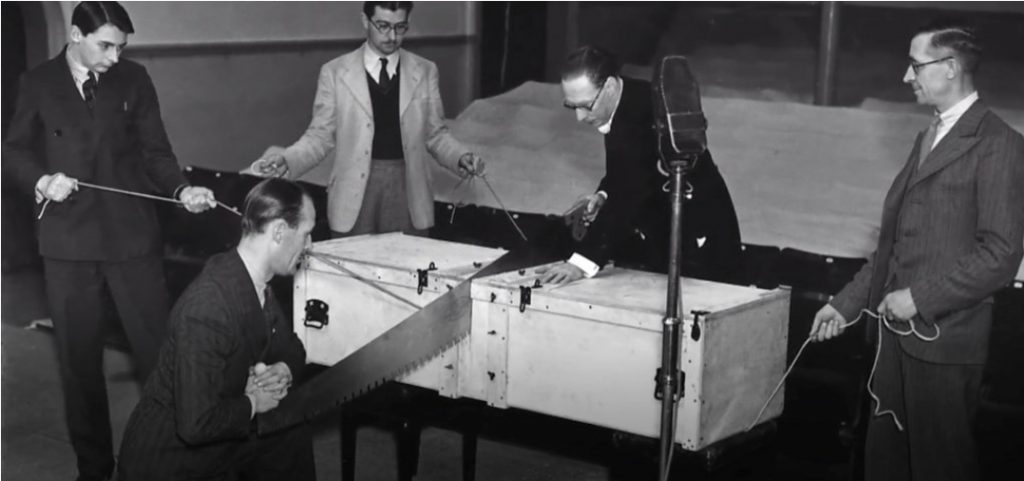
Sunday 17th January 2021 was the centenary of possibly the most famous magical illusion of all – Sawing a Lady in Half.
First performed in public in 1921 – just 12 years after the founding of The Order of The Magi, by P.T. Selbit at Finsbury Park Empire theatre in London, the illusion has since been adapted countless times.
Some magical historians have suggested that the illusion is much older than PT Selbit’s performance, citing the famous French magician Jean-Eugène Robert-Houdin’s Memoirs, written in 1858, where he described a sawing illusion performed by a magician named Torrini. However this description of the illusion is sometimes considered to be a piece of fictional writing.
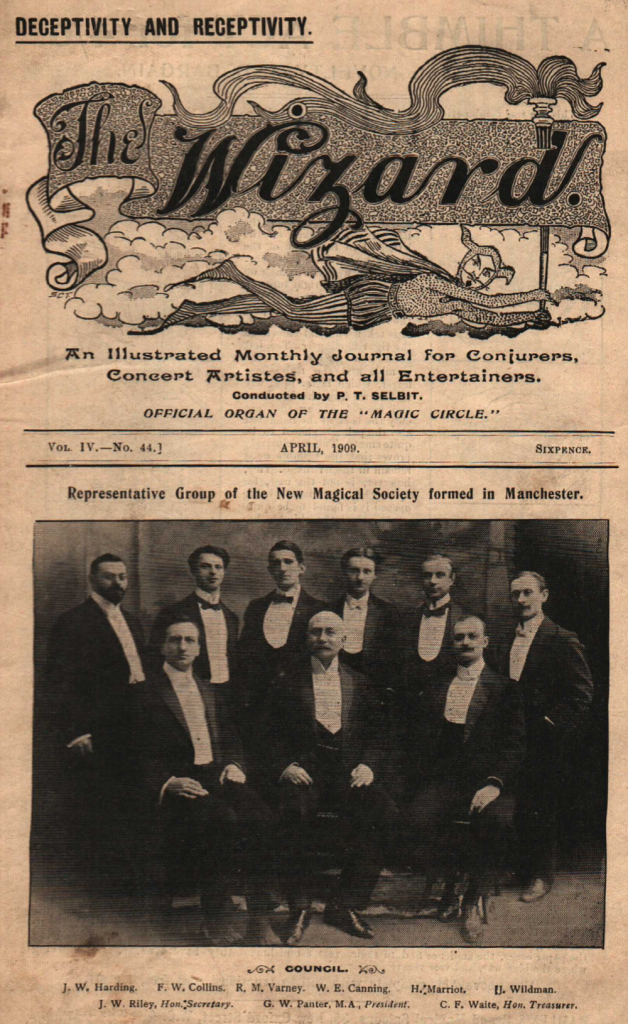
The 1909 announcement of the formation of “a New Magical Society formed in Manchester” on the front page of “Wizard Magazine” published by PT Selbit – the inventor and originator of Sawing a Lady in Half
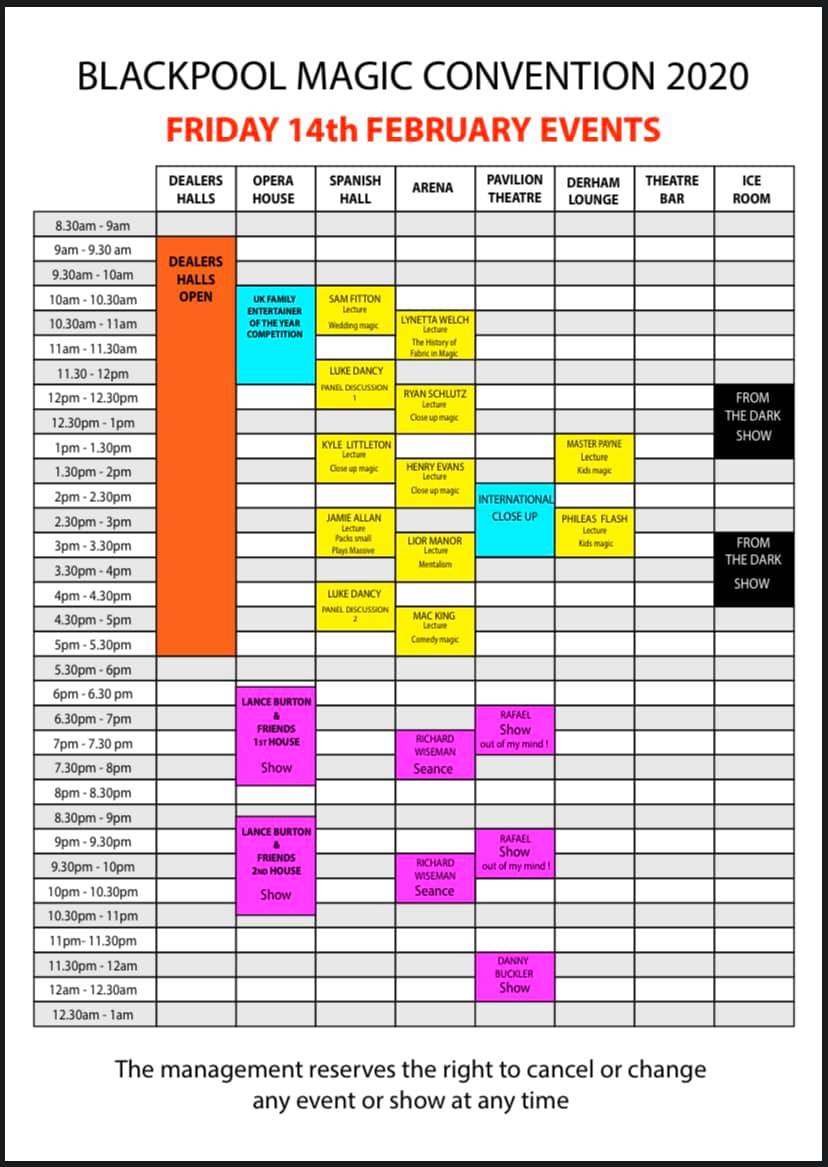
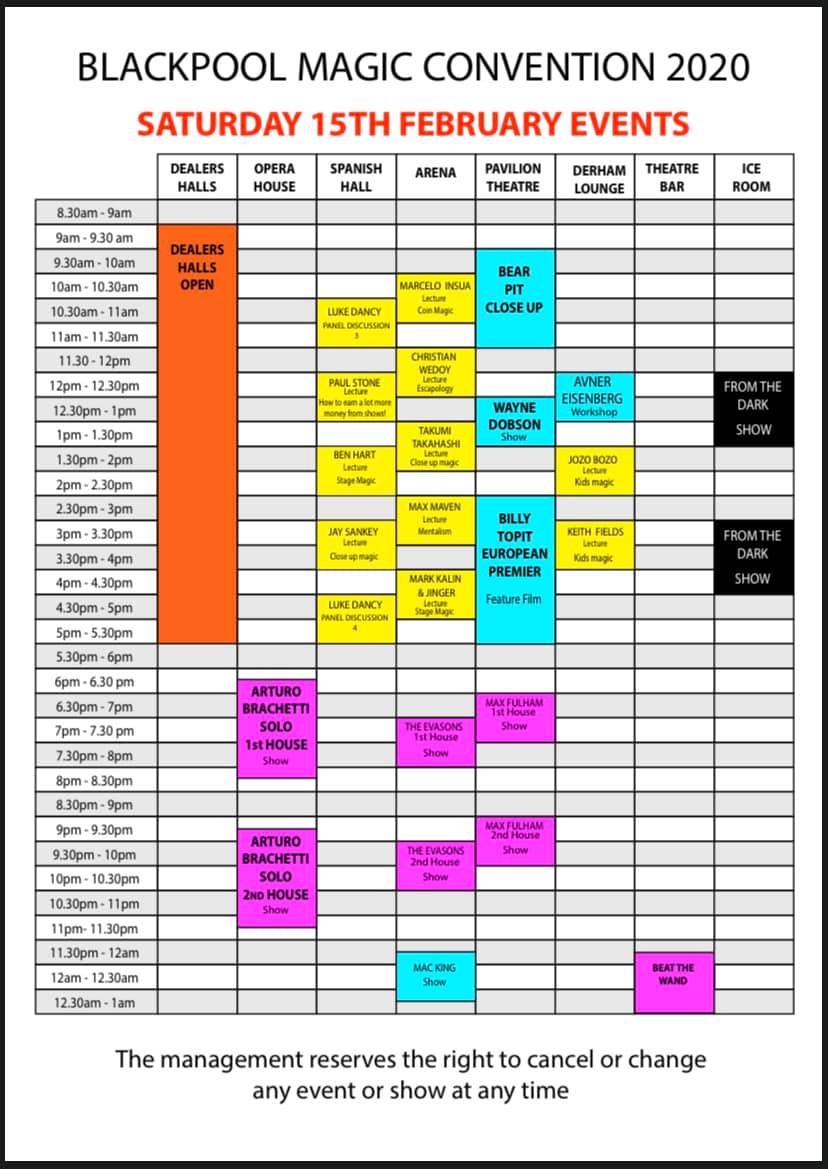
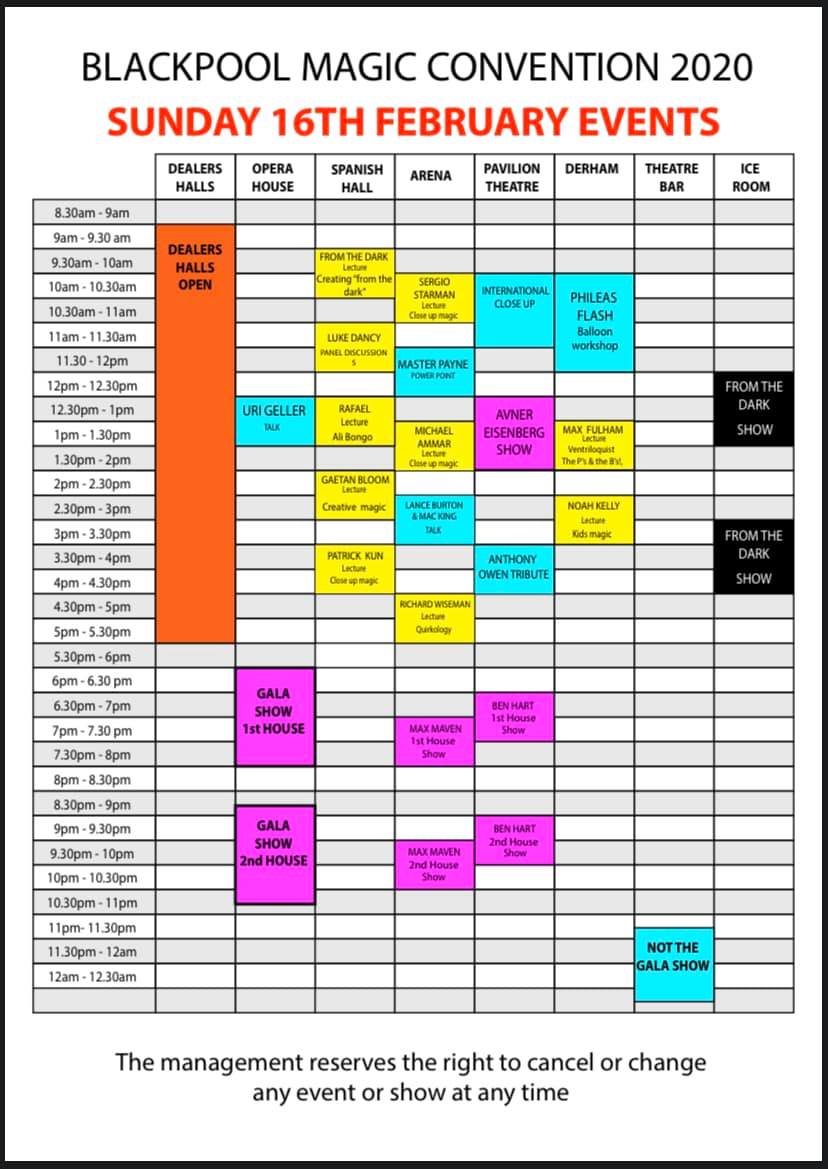
Blackpool Magic Convention is just a few days away now, and many members from The order of The Magi will be travelling from Manchester to Blackpool to enjoy the packed schedule of shows, lectures, and more that is on offer at the world’s biggest magic convention.
Every February, 4,000+ magicians descend on “The Vegas of The North” for a long weekend of magical fun at The Winter Gardens. With three days of wizardry, plus an auction of magic tricks and books, it is the event of the year for magicians.
So what are our top tips for Blackpool Magic Convention?
Wrap up warm, and wear comfy shoes!
Blackpool is in the north of England, and is a seaside resort. It’s likely to be cold, and windy. Whilst all the activities this year take place inside the Winter Gardens, the chances are you won’t be sleeping there, and you will be on your feet for quite some time over the weekend. Take a warm jacket / coat (preferably waterproof) and wear shoes that are comfortable.
Plan your Schedule!
There is so much going on over the weekend, that you are likely to be spoilt for choice. And it would be impossible for the organisers to arrange a schedule that allows everyone to see everything throughout the weekend. We estimate that the convention would need to be on for at least 7 days, to make this possible!
Thankfully the organisers have released a free smartphone app, with a full schedule of the shows, lectures, and more, so you can plan your weekend in advance. It is worthwhile checking out the lists of activities, and if you are not sure whether a lecture or show is going to be “your thing” you can always check out the long list of artistes in the app.
Whilst the events start at around 9am and go on throughout the day until midnight or later, there is always more magic to be found. Many magicians meet up each night in the bar of their B&Bs to chat about the day, show each other tricks, and socialise.
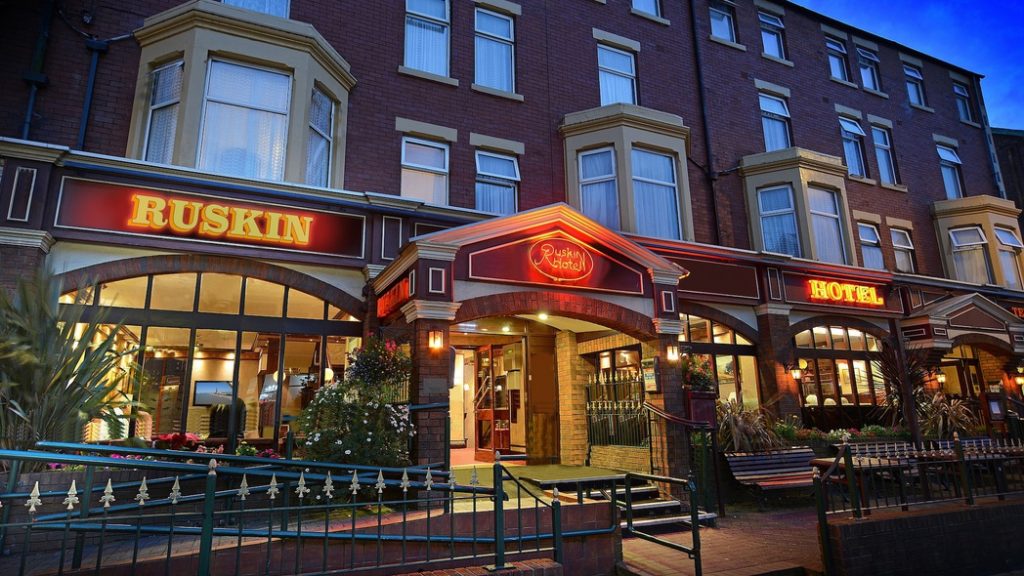
However, there is one place that is famous for Magic in Blackpool during the weekend of the convention – The Ruskin Hotel – where hundreds, possibly thousands of magicians will gather after the convention finishes, to enjoy several more hours of magic, mentalism and the occasional beer! Be warned – it will be extremely busy, but it is worth the visit.
Don’t forget to Eat & Sleep!
We don’t want to sound like your parents, but…
It’s a long weekend with lots of beer flowing, and some very late nights. Whilst you might want to try and be the last person in the hotel bar at 6am, don’t forget that you will need some sleep… and food. It would be a shame to miss a day of the convention because you are catching up on sleep after a very wild night.
Similarly, you aren’t going to get the most out of the weekend if you don’t eat. Thankfully Blackpool has plenty of cafes, restaurants, takeaways, and pasty shops, catering for almost everyone.
Take your Time in the Dealers Hall
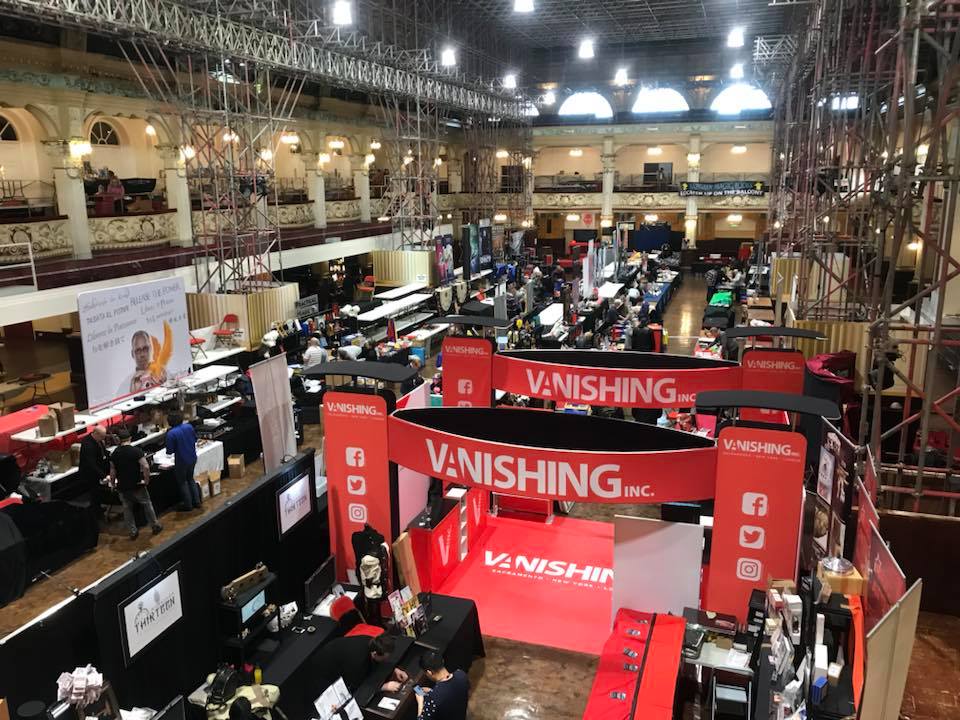
We’ve all done it! Wandered around the 150+ magic dealers, and bought something on impulse, only to regret it almost straight afterwards. The dealers are there for the full three days, and most will have plenty of stock with them. Walk around, have a look, watch the demos, and ask questions. Just because you have watched a dealer demonstrate a magic trick, don’t feel that you should have to buy it immediately.
Take some time to consider if you will really use that trick; If it is suitable for you, and your act; or if it will end up in that drawer of unused props. Talk to other magicians and get their advice, and even check out reviews of the effect on sites like The Magic Cafe.
Dealers know that many magicians won’t buy a magic trick until they have walked around the dealers hall at least once. Some magicians won’t buy anything until the Sunday afternoon.
Waiting until Sunday can be a gamble though – sometimes effects that have been advertised as “limited quantity” might sell out early on at the convention. But the flip side is that one or two dealers will reduce their prices on certain items on the Sunday afternoon, just to save them taking stock back with them.
And don’t forget that the dealers are situated around the convention – including the Horseshoe, and Balcony!
Don’t forget your Photo ID!
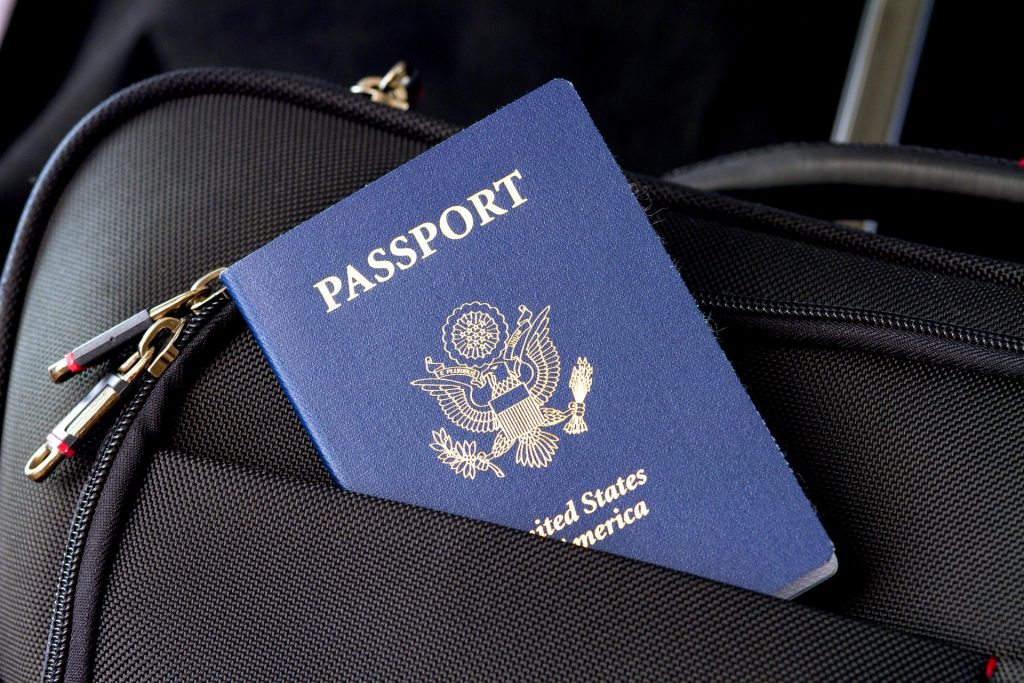
The organisers of Blackpool Magic Convention are insisting that anyone with a pre-booked ticket presents photo ID on arrival. According to their (very useful) Facebook page, Driving Licences, Passports, Bus Passes, and Work IDs are all acceptable, as long as the name on the ID matches the name on the ticket. This of course might cause issues for those who booked their tickets using their stage names without thought.
Leave the Fire Wallet in your Pocket!
Yes, it’s a magic convention. Yes, it’s a weekend of fun. Yes, we all get excited about Blackpool…
But the poor bar maid who is trying to serve 50+ magicians at the bar is really not going to be impressed when a wallet bursts into flames as a magician pays for their beer! The chances are, she, and every other barstaff in the town will be subjected to fire wallets at least 100 times every day!
Save them the pain, and let them get on with serving someone else who is desperate for a drink.
You know who would like to see a trick? Other magicians…
No matter what your level of experience, don’t be afraid to watch other magicians perform at the convention, and elsewhere, and to show a favourite trick or two of your own. Bar Staff, and Hotel Receptionists might not appreciate lots of magic (but if they ask to see a trick, feel free!), but your fellow magicians will.
You can learn something from any lecture
A big part of the convention is the wide range of lectures that have been arranged. If you find yourself with some spare time, go and see an extra lecture – even if it is about an area of magic that you wouldn’t usually focus on. There is always something you can learn from the masters of their craft.
And whilst we are on the subject of lectures… please don’t sit through a lecture riffling playing cards or messing about on your phone. It can be distracting for others!
Stuff to pack that you might not have thought about
No doubt you’ve already considered taking the usual things – clothes, wash kit, mobile phone, wallet, cash card etc. Here a a few items you might not have considered yet…
Pain Killers (for the morning after a night in the Ruskin)
Bottled Water (great for the hotel room)
Pot Noodles (again, a great addition to the hotel room when you realise you haven’t eaten all day, and it is 3am)
Phone Power Bank (is your phone’s battery really going to last all day?)
Hand Sanitizer
Throat Sweets & Mints
An Extra Pack of Cards
Quality Toilet Roll (a must when travelling for our webmaster!)
Pen & Paper (for making notes at magic lectures, jotting down items you’ve seen in the dealers hall etc)
Enjoy The Magic of Blackpool
It is a long weekend, with lots going on… and if this is your first time going to Blackpool Magic Convention, you are going to love it!
Enjoy the magic!
And if you see a member of The Order of The Magi, say hello!
(or the link between a group of Manchester magicians & The Sex Pistols!)
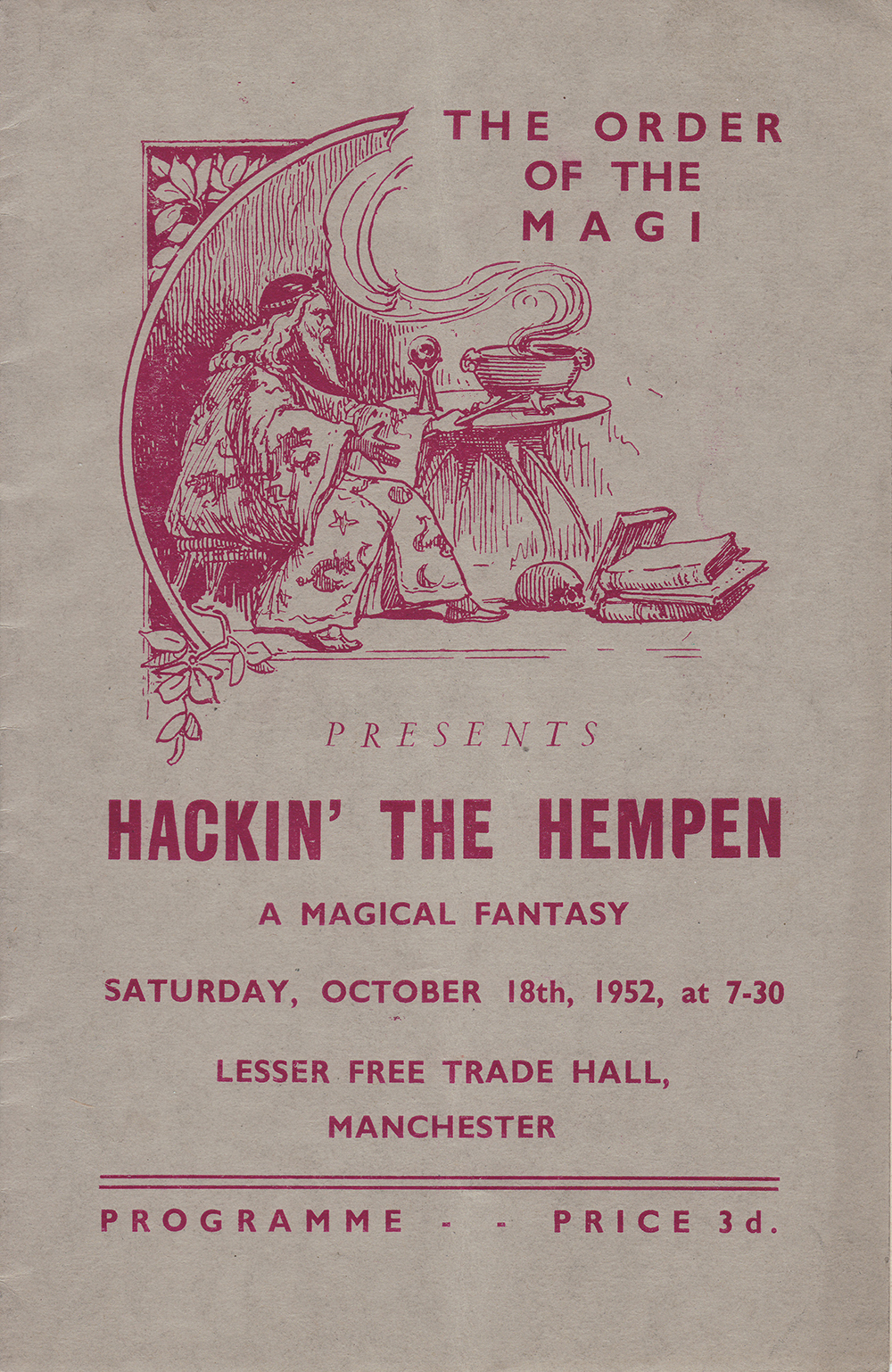
Recently, one of our members was lucky enough to be able to obtain a programme from a 1952 production by members of The Order of The Magi, entitled “Hackin’ The Hempen” (subtitled ” A Magical Fantasy”). We are still looking into the origins of such a bizarre show title, and whilst various theories have been suggested, we are keeping an open mind at this time.
The show took place at The Lesser Free Trade Hall, Manchester on Saturday 18th October 1952, just 1 year after the venue reopened after being damaged in 1940 during the Manchester Blitz.
The Free Trade Hall
Located on Peter Street, The Free Trade Hall is an important part of Manchester’s history. Built in 1853 – 1856, on the site of the Peterloo Massacre (1819), the venue would play host to many famous names over the years – Charles Dickens, Benjamin Disraeli, and Winston Churchill, and would be the permanent residence to The Hallé Orchestra.
The Lesser Free Trade Hall
The Lesser Free Trade Hall was a smaller venue, upstairs within the same building, which was to later host the Sex Pistols famous concert in 1976, that inspired many bands including the Buzzcocks, Joy Division, New Order, The Smiths, Happy Mondays and Oasis; as well as being partly responsible for Manchester’s iconic music scene, including The Hacienda, Madchester, Factory Records, and the indie scene:
As can been seen from the scan below, The programme, costing 3d was decorated with a lovely line drawing of a bearded wizard, dressed in mystical looking robes, surrounded by a cauldron, skull, spell books and other magical items. This drawing was in fact part of the letterhead used in the 1940’s to decorated the society’s “Magi Magazine”.
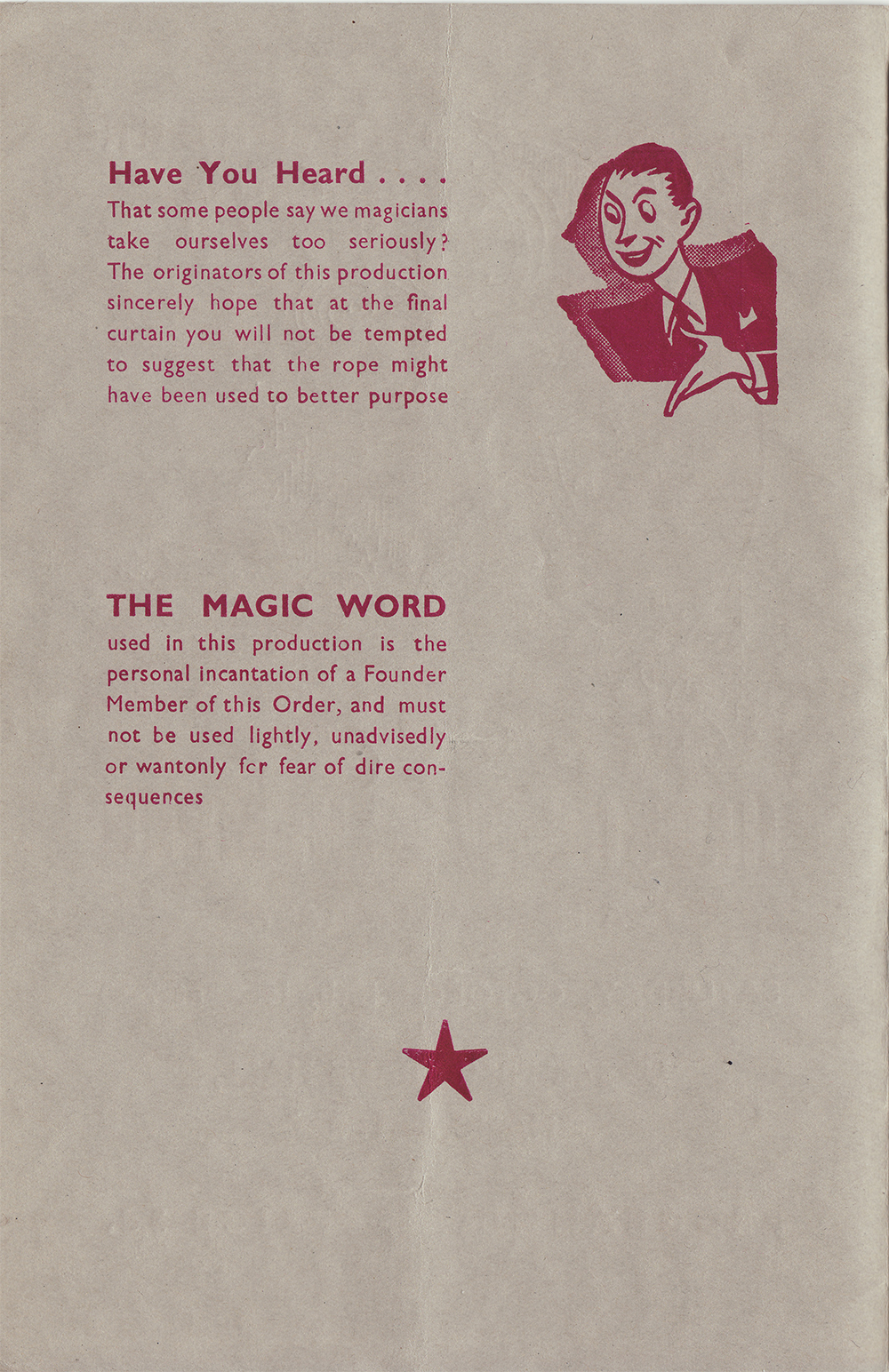
The Front Inside Cover
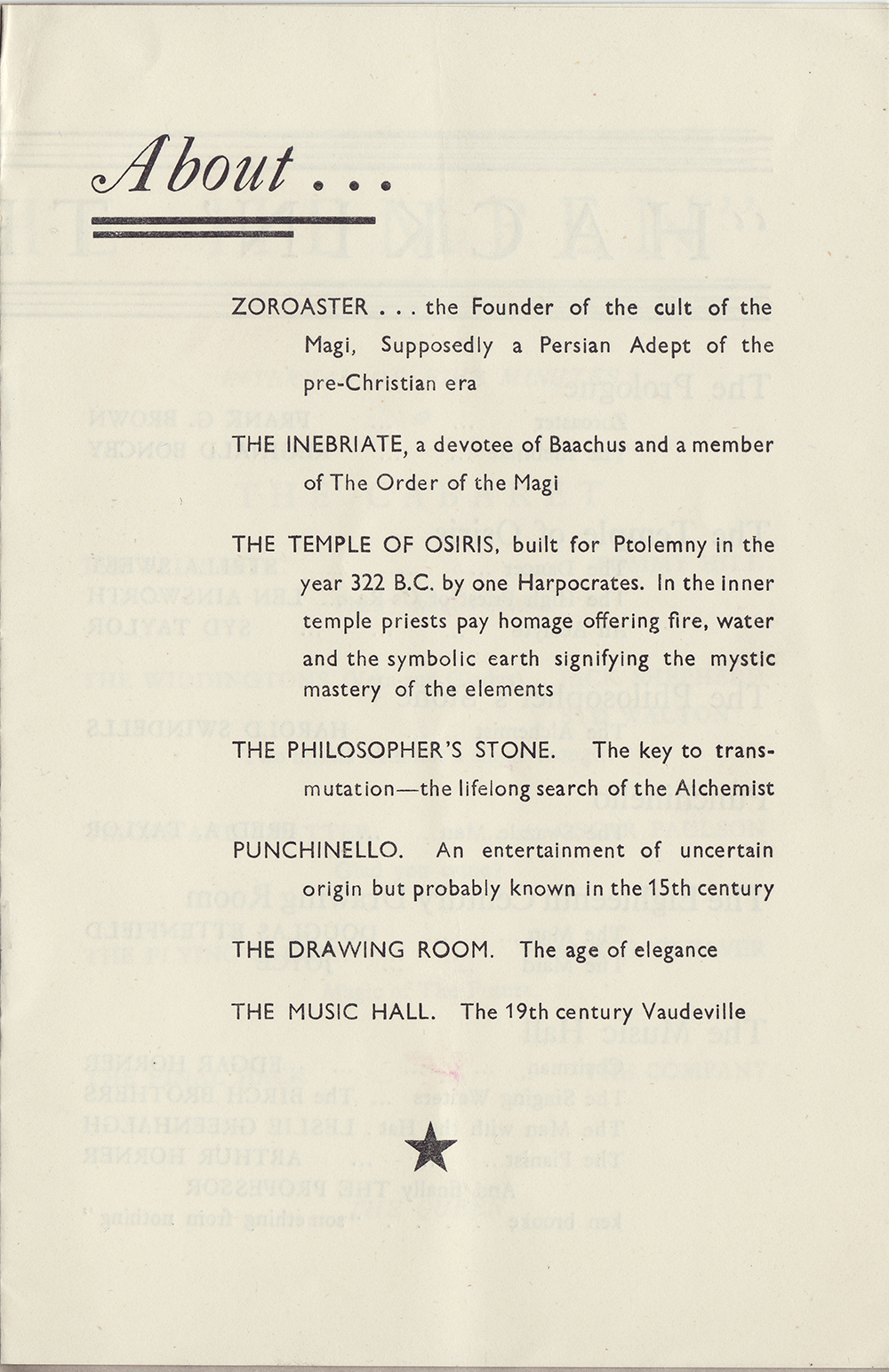
Page 1
Centre Pages – The Show
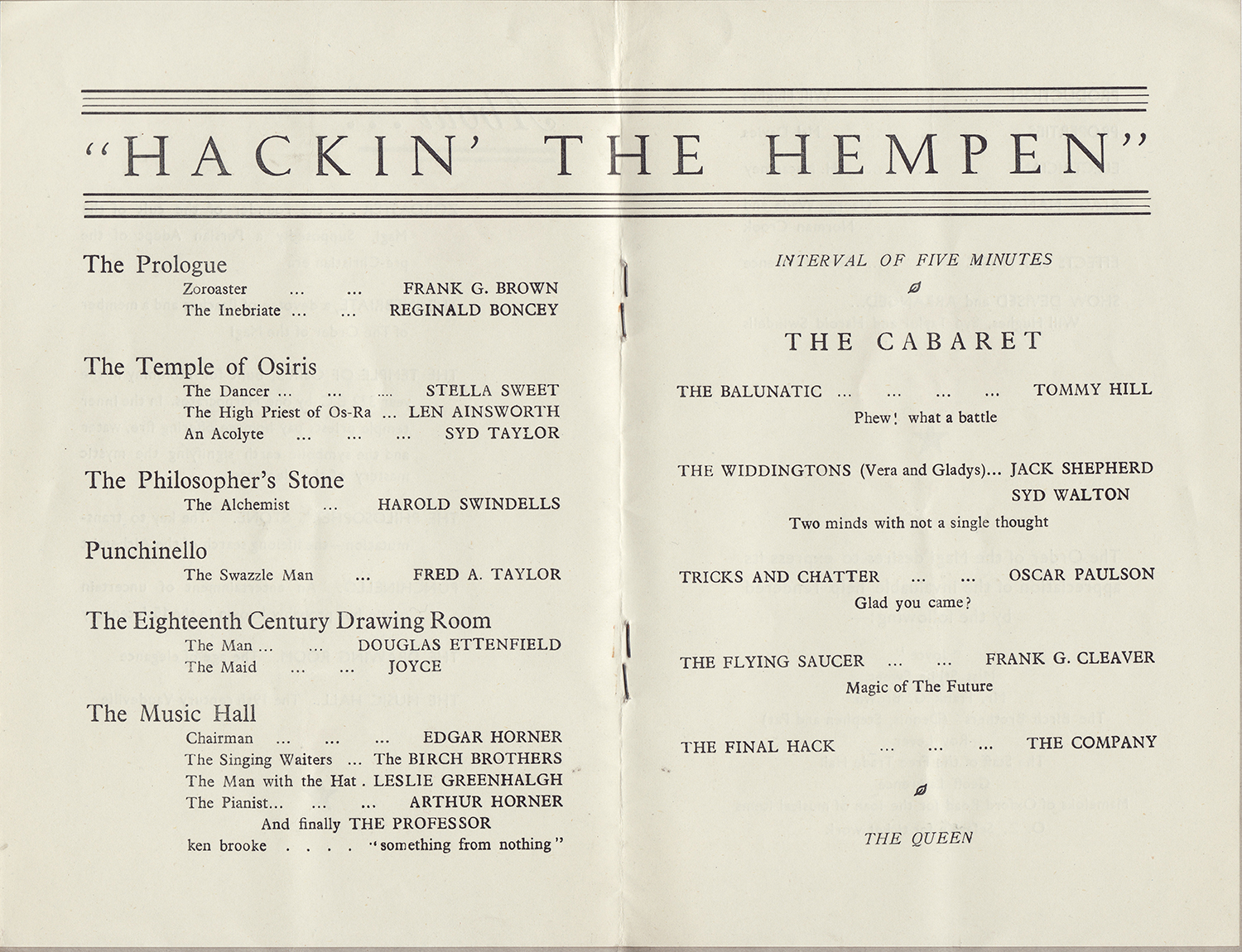
The centre pages detail the order of the evening’s show, and the performers. It appears that the show’s premise was a “History of Magic & Entertainment” starting with Zoroaster, moving through the Magic of Egypt (The Temple of Osiris), Alchemy, Punch & Judy performed by The Order of The Magi’s President Fred A. Taylor – “The Swazzle Man”, and 19th Century Music Hall. The first half of the show was closed by no other than Magical Legend Ken Brooke.
It is interesting to see that the show’s interval lasted only 5 minutes. Today, even in the smallest of venues, it is impossible to imagine that an interval would last any less than 15 minutes. Was the director being optimistic, or are modern day audiences more demanding of a longer break?
The second half of the “Magical Fantasy” is dedicated to up to date, and futuristic Cabaret. We can only assume that Tommy Hill “The Ballunatic” was a balloon modeller, and that Jack Shepherd & Syd Walton performed in drag as “The Widdingtons” – “Two minds with not a single thought!”; no doubt a parody of the famous contemporary Australian Telepathy duo “The Piddingtons”.
The penultimate part of the evening was Frank Cleaver’s “Flying Saucer” subtitled “Magic of the Future”. It would certainly be interesting to see if he had indeed predicted the future of magic!
After over 2 hours of magical entertainment, the show was to close with a Finale of the entire company, followed by “The Queen” – The National Anthem – a tradition that has died in most theatrical productions in the past 60 years.
The Cast
This is the only online record of The Order Of The Magi’s production “Hackin’ The Hempen” from 1952. So it seems fitting that we include a full list of all the cast, the majority of whom would have been members of the only Magic Society in Manchester. Perhaps it will help anyone in the future researching any of the magicians, either for personal or professional reasons:
Frank G. Brown – Zoroaster Reginald Boncey – The Inebriate Stella Sweet – The Dancer Len Ainsworth – The High Priest of Os-Ra Syd Taylor – An Acolyte Harold Swindells – The Alchemist Fred A. Taylor – The Swazzle Man (President of The Order of The Magi at the time) Douglas Ettenfield – The Man Joyce – The Maid Edgar Horner – Chairman Dennis Birch, Stephen Birch and Pat Birch – The Birch Brothers – The Singing Waiters Leslie Greenhalgh – The Man With The Hat Arthur Horner – The Pianist Ken Brooke – The Professor Tommy Hill – The Balunatic Jack Shepherd – Vera Widdington Syd Walton – Gladys Widdington Oscar Paulson – Tricks & Chatter Frank G. Clever – Magic of The Future (The Flying Saucer)
Page 4
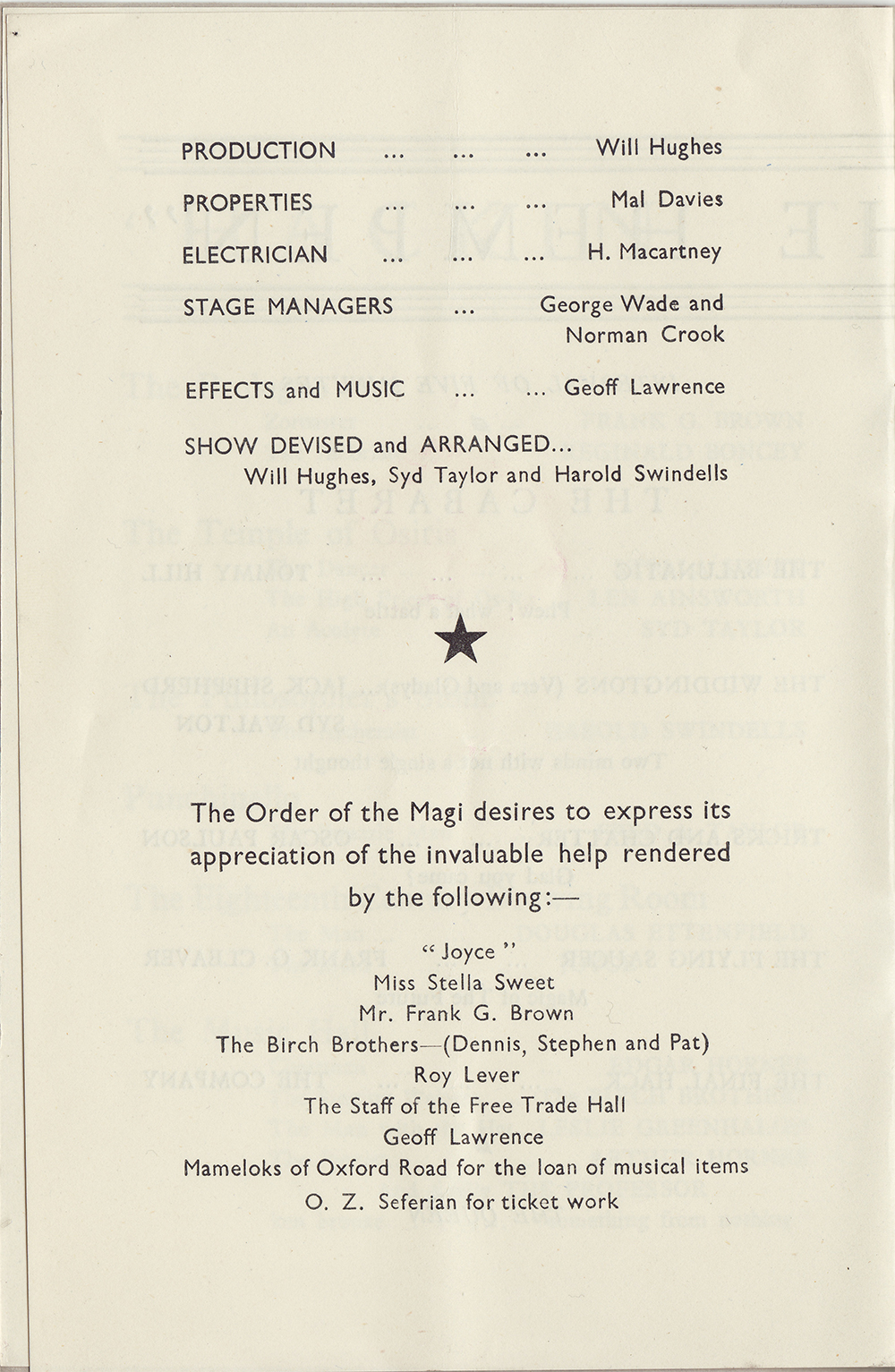
Of course, a programme for a such a magical performance wouldn’t be complete without credit to those behind the scenes who helped to put it all together.
Production – Will Hughes Properties – Mal Davies Electrician – H. Macartney Stage Managers – George Wade & Norman Crook Effects and Music – Geoff Lawrence Show Devised & Arranged by Will Hughes, Syd Taylor and Harold Swindells
The Order of The Magi desires to express its appreciation of the invaluable help rendered by the following –
“Joyce” Miss Stella Sweet Mr. Frank G. Brown The Birch Brothers – (Dennis, Stephen and Pat) Roy Lever The Staff of The Free Trade Hall Geoff Lawrence Mameloks of Oxford Road for the loan of musical items O. Z. Seferian for ticket work
The Inside Back Cover
The last page of the programme gives us a clue as to the length of the performance, declaring “Carriages at 9.45pm approx”.
Final Thoughts
Reading and researching this programme has been an opportunity to learn a little more about The Free Trade Hall in Manchester, The Order of The Magi, it’s members, and activities nearly 70 years ago. Without currently having any more information about each act, it is an opportunity to imagine what magic tricks were performed that night in Manchester City Centre, and if a similar show was to be performed today with the same programme, how each act might differ. There will be more information on the show in at least one issue of The Order of The Magi’s society magazine “The Magi” from 1952, and hopefully soon we will be able to provide you with more details.
There is no doubt however, that any of the performers on Tuesday 18th October, 1952 could imagine that the stage they were performing on would be host to one of the world’s greatest punk bands just 24 years later.
Can You Help with our Research?
It would be great to hear from anyone related to any of the magicians, or other performers, who took part in “Hackin’ The Hempen”. We would love to see photos of the performers (especially any promotional material etc). Perhaps you have an 1952 issue of The Magi Magazine that details the planning of the show, or features a report of each act’s performance?
Unsurprisingly, after 110 years, our archives hold many interesting items, many of which have a great historical value to magicians, that may have been long forgotten, if it wasn’t for the foresight of the committee to save them.
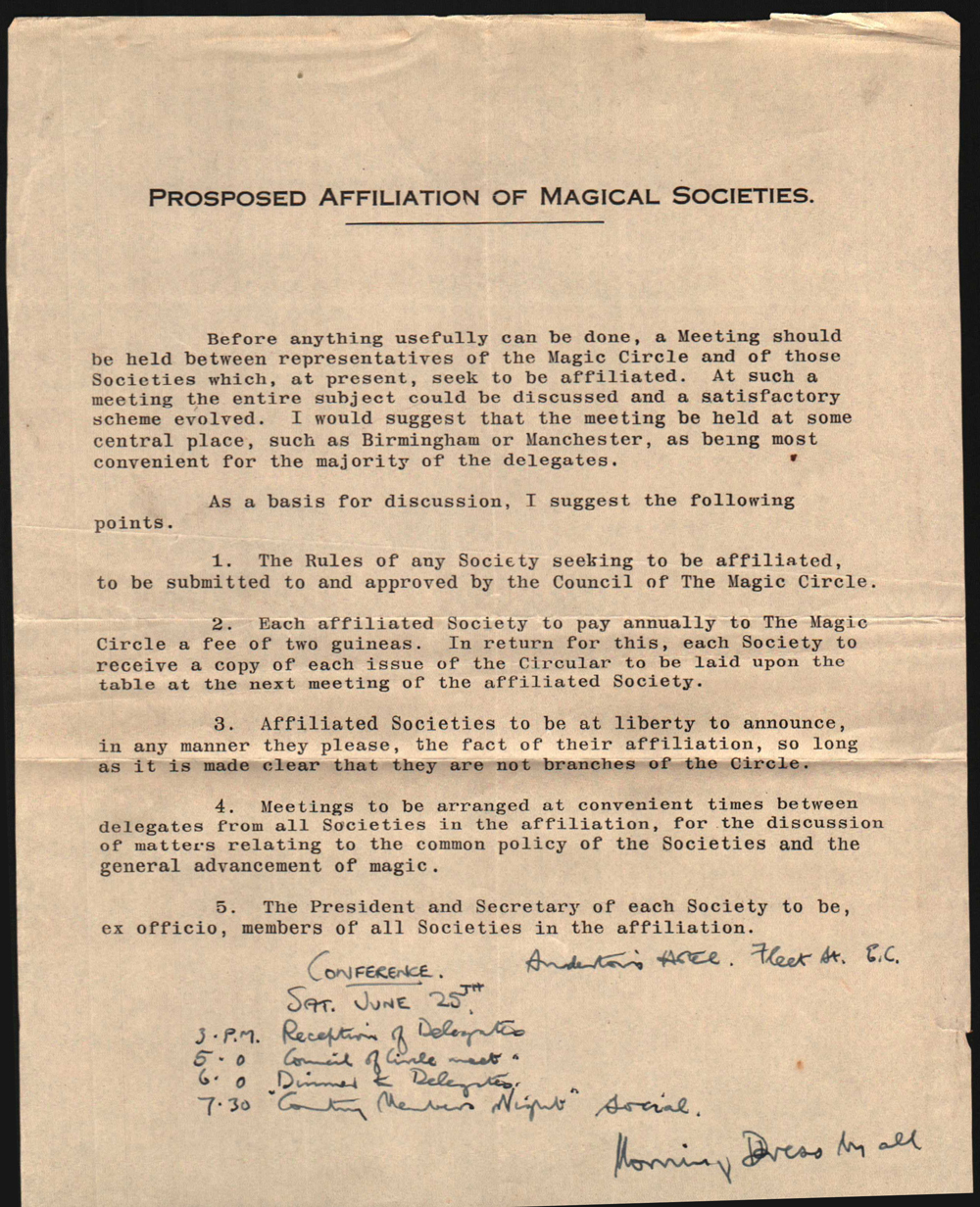
Several documents within the collection refer to the forming of an affiliation between various Magic Societies in the U.K. (and around the world) with one of the most famous magic clubs – The Magic Circle.
The affiliation was active between 1921 and 1944, before becoming The National Association of Magical Societies (N.A.M.S).
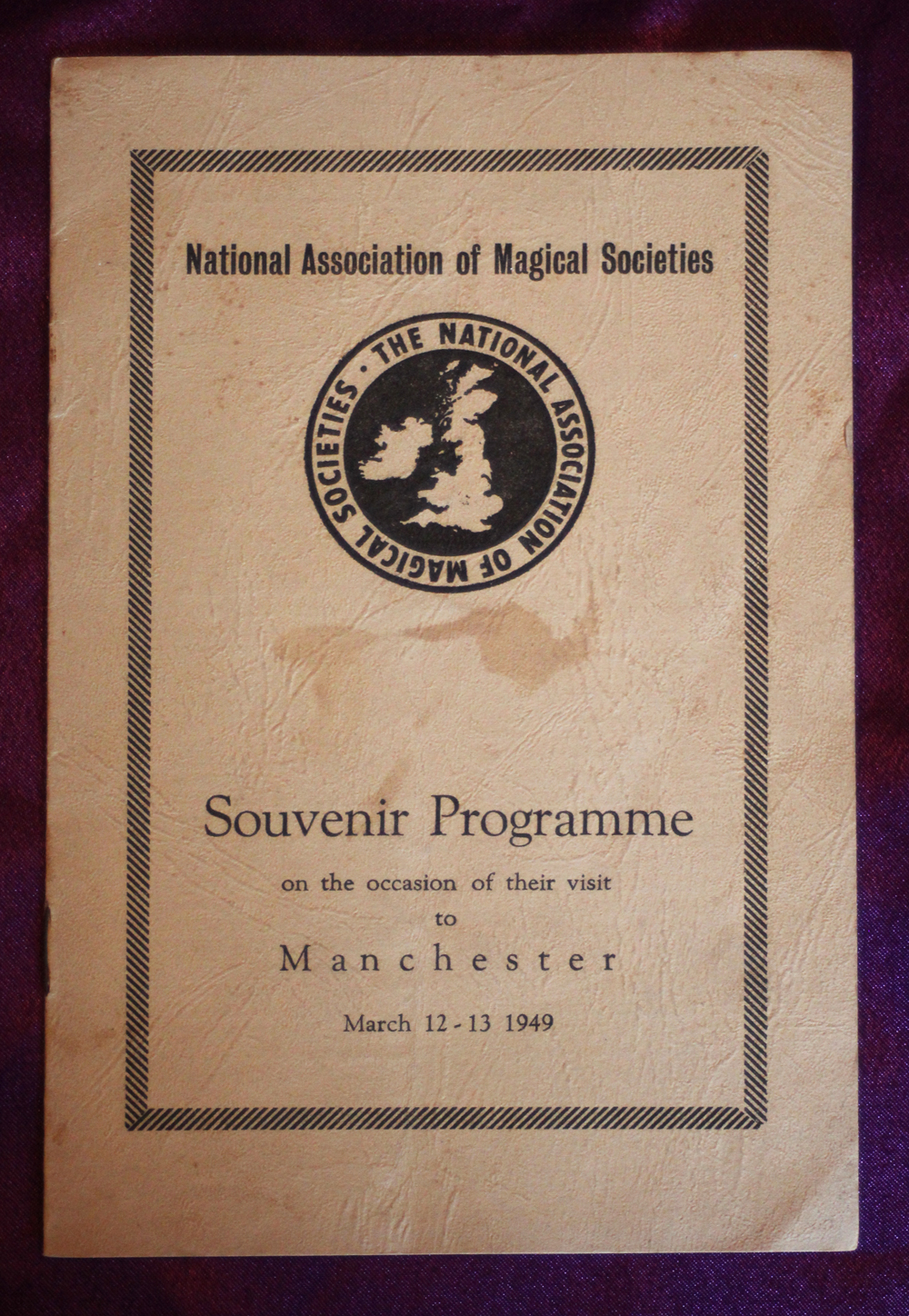
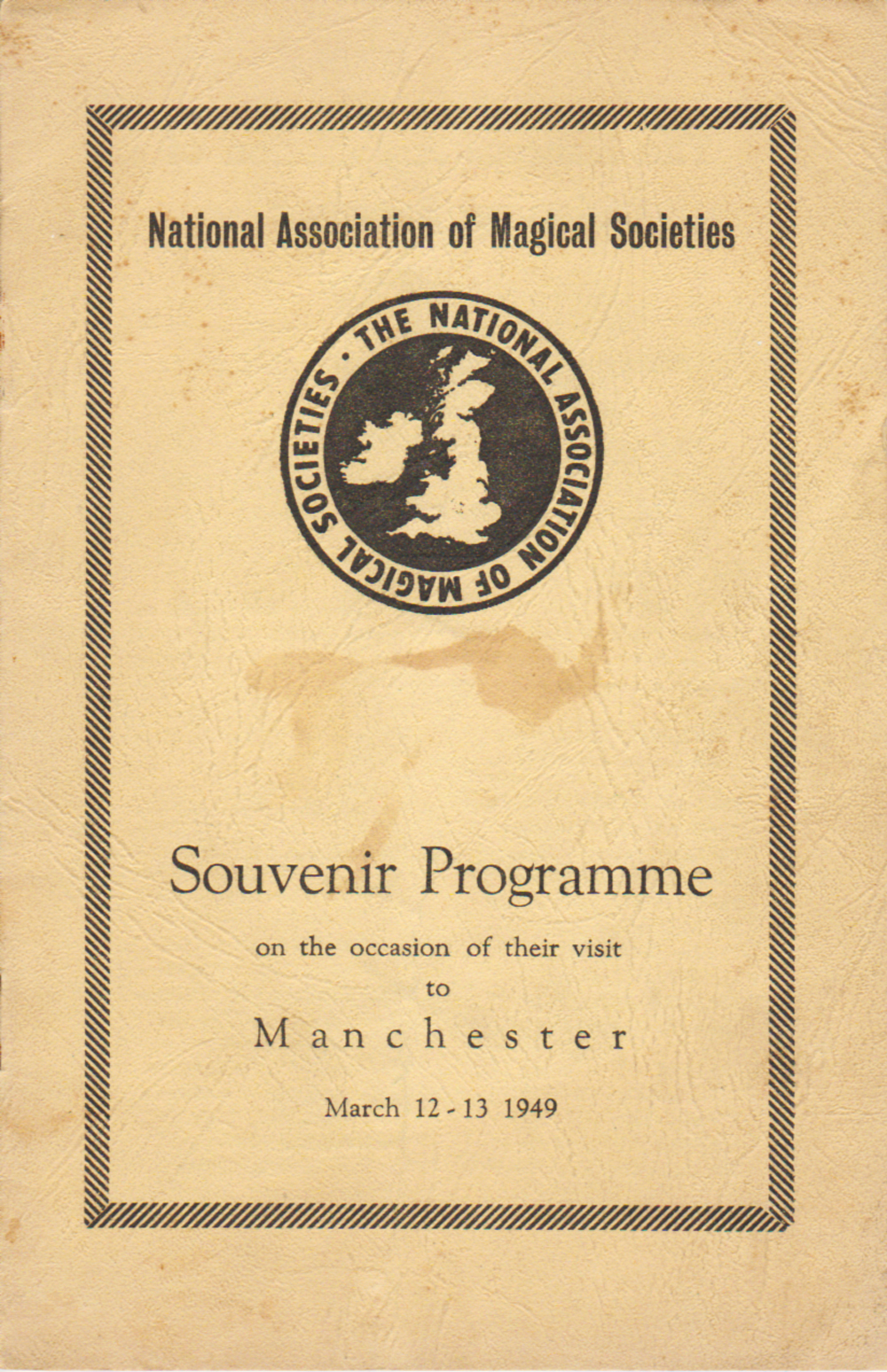
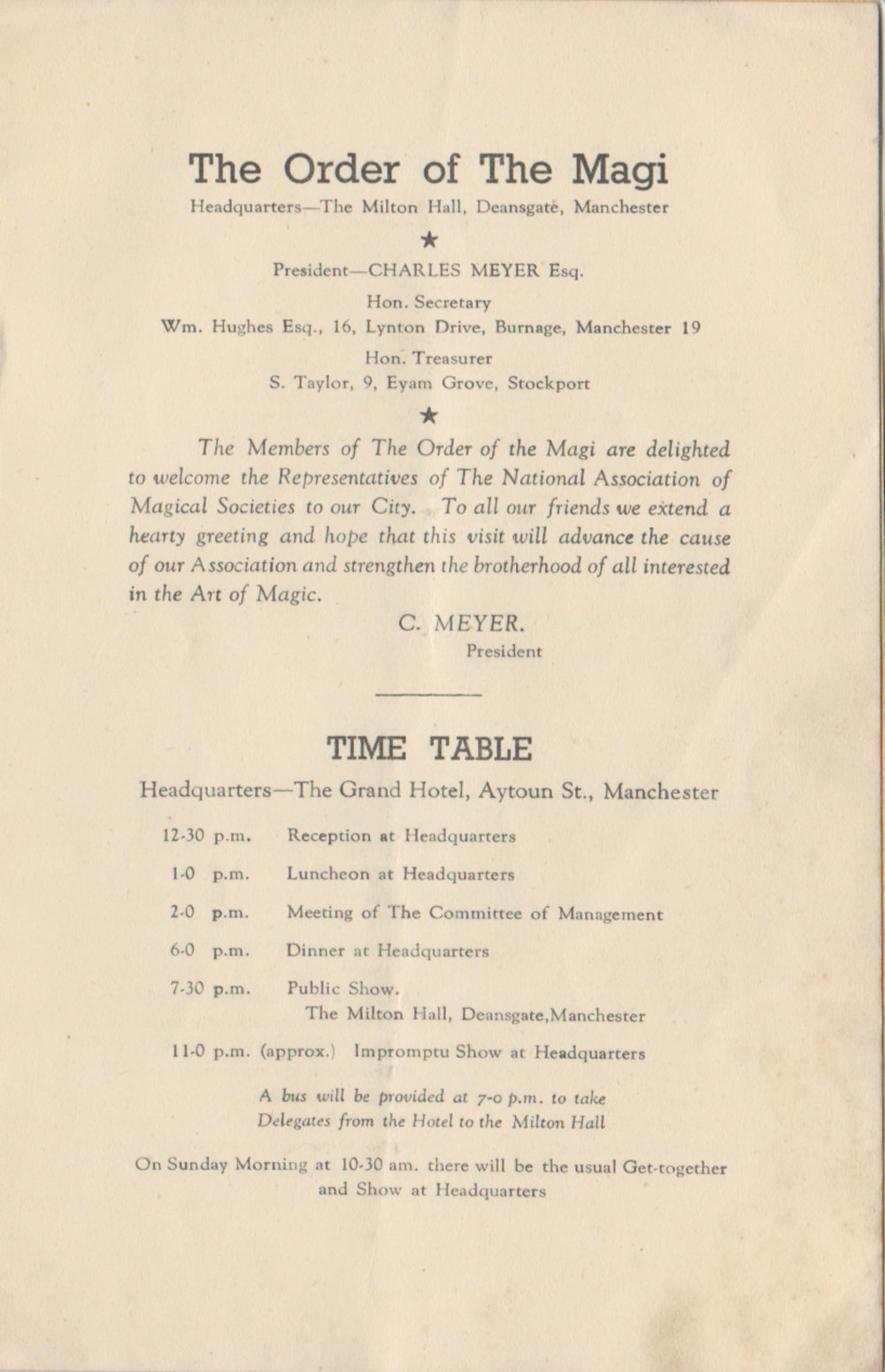
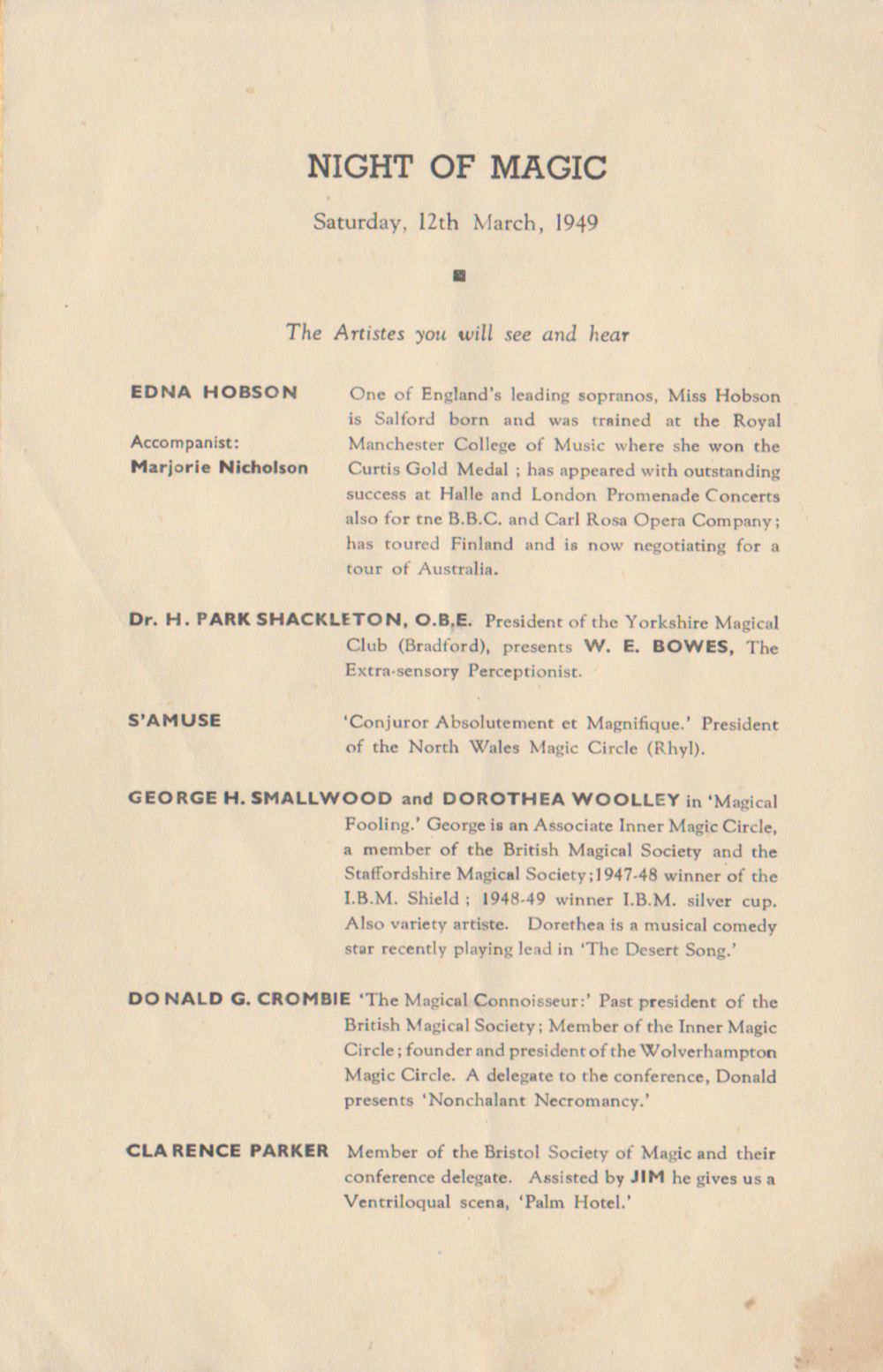
Five years after the formation of N.A.M.S. The Order of The Magi hosted a weekend-long event in Manchester, for representatives of other Magic Societies consisting of Dinner, Committee Meeting, Shows etc.
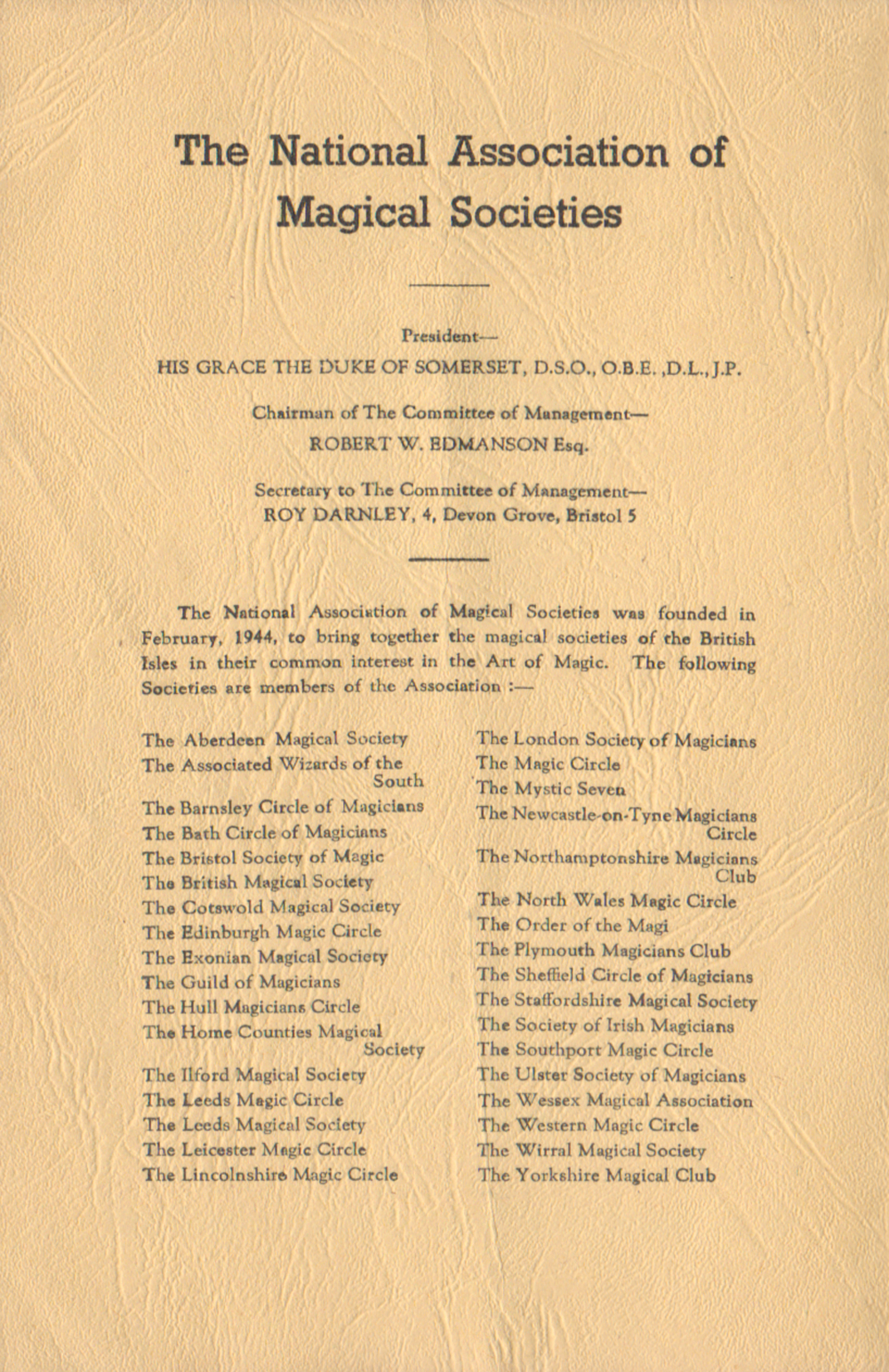
In 1949, the National Association of Magical Societies included the following clubs as members:
The Aberdeen Magical Society
The Associated Wizards of The South
The Barnsley Circle of Magicians
The Bristol Society of Magic
The British Magical Society
The Cotswold Magical Society
The Edinburgh Magic Circle
The Exonian Magic Society
The Guild of Magicians
The Hull Magicians Circle
The Home Counties Magical Society
The Ilford Magical Society
The Leeds Magic Circle
The Leeds Magical Society
The Leicester Magic Circle
The Lincolnshire Magic Circle
The London Society of Magicians The Magic Circle The Mystic Seven The Newcastle -on-Tyne Magicians Circle The Northamptonshire Magicians Club The North Wales Magic Circle The Order of The Magi The Plymouth Magicians Club The Sheffield Circle of Magicians The Staffordshire Magical Society The Society of Irish Magicians The Southport Magic Circle The Ulster Society of Magicians The Wessex Magical Association The Western Magic Circle The Wirral Magical Society The Yorkshire Magical Club
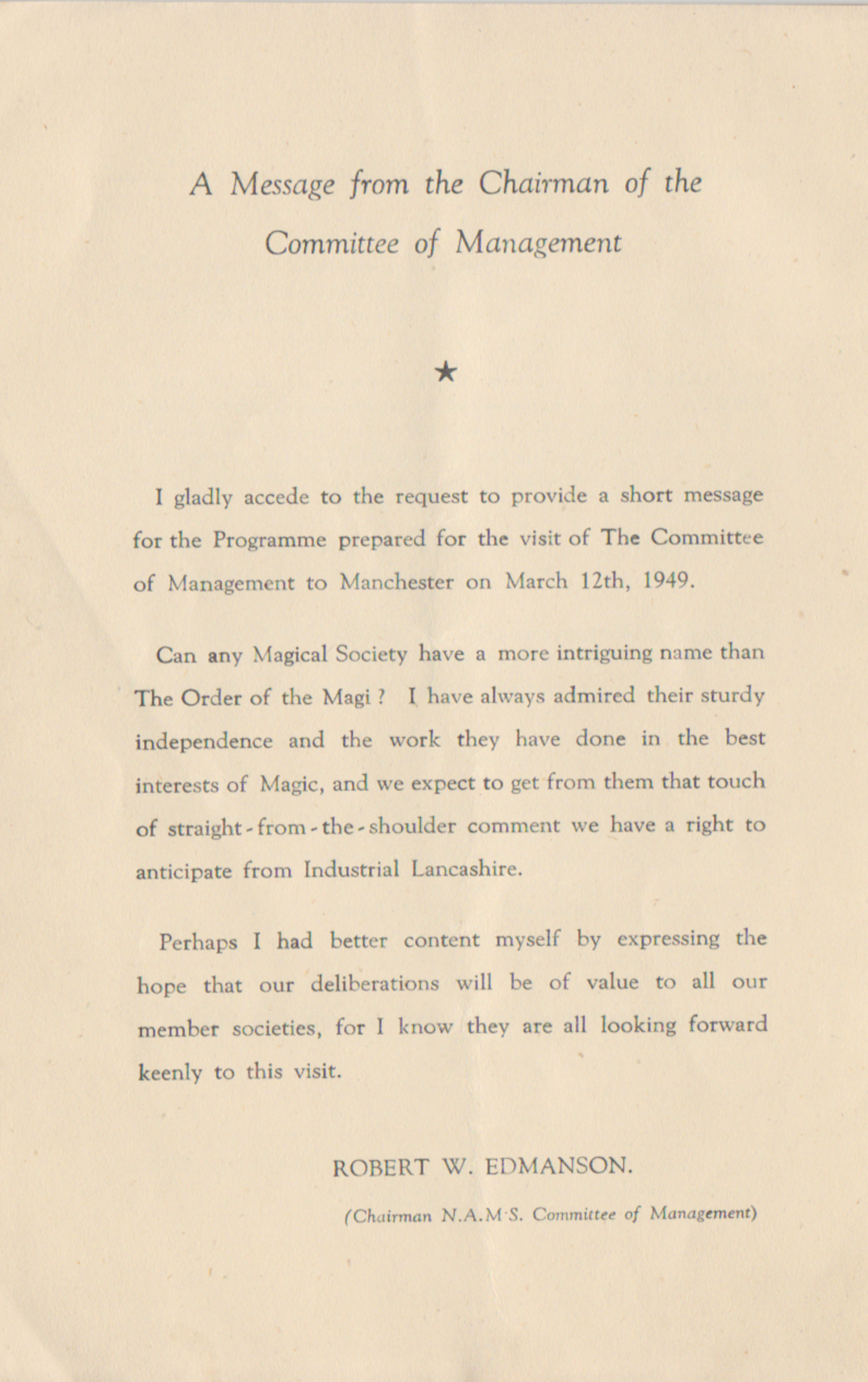
In “A Message from the Chairman of the Committee of Management” at the back of the N.A.M.S. Souvenir Programme, Robert Edmanson wrote:
“I gladly accede to the request to provide a short message for the Programme prepared for the visit of The Committee of Management to Manchester on March 12th, 1949.
Can any Magical Society have a more intriguing name than The Order of the Magi ? I have always admired their sturdy independence and the work they have done in the best interests of Magic, and we expect to get from them that touch Magic of straight- from – the – shoulder comment we have a right to straight from Industrial Lancashire.
Perhaps I bad better content myself by expressing the hope that our deliberations will be of value to all our member societies, for I know they are all looking forward keenly to this visit.“
ROBERT W. EDMANSON. (Chairman NA.M.S. Committee of Management)
On 7th June, 1952, Magic Magazine “Abra” reported that The National Association of Magical Societies was to be liquidated, with the remaining funds to be distributed amongst the thirty six member societies.
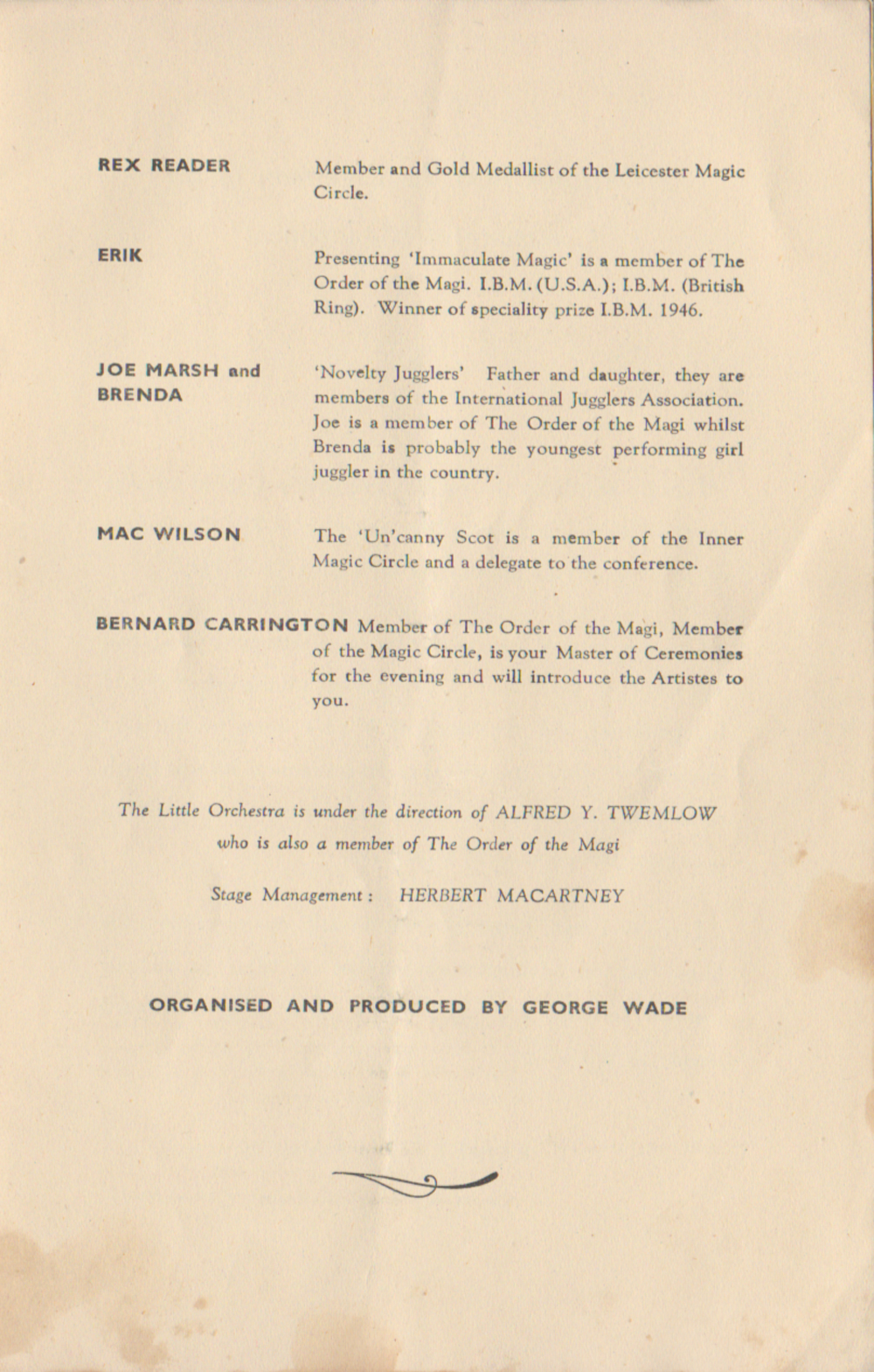
Further Images from the Souvenir Programme of March 12 – 13th 1949:
An amateur magician accidentally turns his wife into a sofa and his two kids into armchairs. He starts to panic.
He tries every trick in the book but none work so, in desperation, he decides to take them to hospital. Once at the hospital, the magician spends a sleepless night while the medical staff run numerous tests on the unfortunate woman and children.
Finally, the head doctor comes out into the corridor to speak to the magician. “How are my family?” he asks worriedly, “Are they alright?”